
By Dr. Hajeera Banu
Prologue
The Question Beside the Instrument Tray
There are questions patients ask that disappear the moment the appointment ends.
And then there are questions that follow a doctor home.
It was an ordinary clinical day.
Appointments were running as usual.
Instructions had been given.
A procedure had concluded.
The instruments had been arranged back onto the tray.
A patient looked at them quietly for a moment.
Then pointed.
“Doctor… who invented the scalpel?”
I smiled.
Not because I knew the answer.
But because I realised I did not know it well enough.
Before I could answer, the questions continued.
“How did they perform surgery before scalpels?”
“If they didn’t have blades… how did they study anatomy?”
“And what was the first surgery ever done?”
In dentistry and surgery, we answer questions every day.
Why a tooth fractures.
Why bone resorbs.
Why implants integrate.
But sometimes a patient asks a question that reminds us that medicine did not begin with us.
The consultation moved on.
The next patient arrived.
The clinic closed.
Yet those questions remained.
That evening, curiosity did what curiosity always does.
It opened books.
One article became another.
One text led to another manuscript.
One surgeon led to another civilization.
And unexpectedly, a simple question about a scalpel became a journey into the oldest surviving history of medicine and surgery.
What I discovered was this:
Surgery did not begin with instruments.
It began with observation.
Before the Scalpel — The Earliest Operations
Long before stainless steel, before operating lights, before sterilisation, surgery already existed.
Among the earliest known procedures identified archaeologically is trepanation—the deliberate creation of openings in the skull.
Stone tools were likely used.
Some patients survived.
The healed margins of ancient skulls still remain.
This is extraordinary.
It means the earliest surgeons operated without modern anatomy.
Without imaging.
Without textbooks.
Yet they observed.
And observation became experience.
Egypt — When Medicine Became Documentation
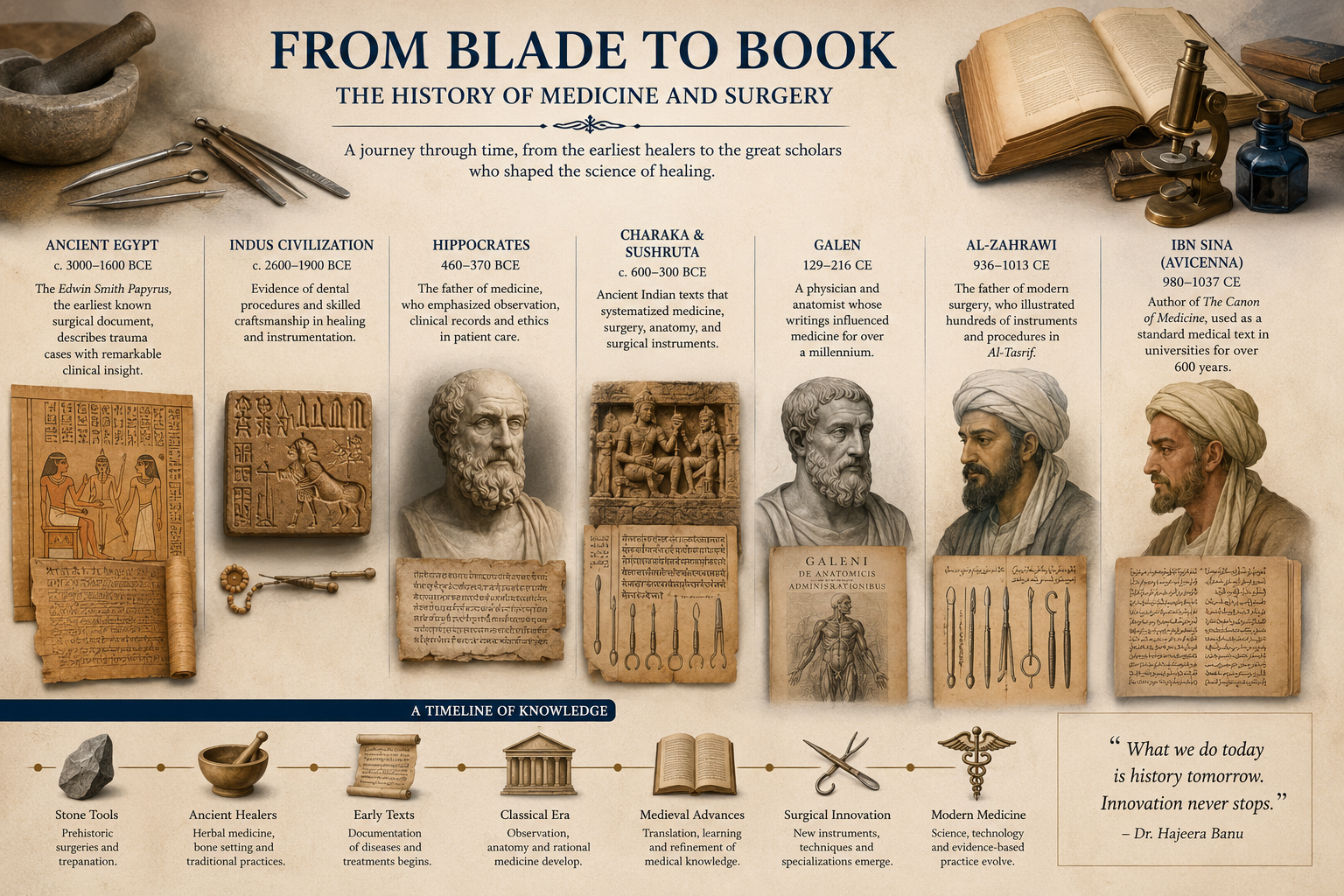
The earliest surviving surgical writing appears in ancient Egypt.
The Edwin Smith Papyrus presents medicine in a voice modern clinicians may find unexpectedly familiar.
Each case proceeds methodically:
Examination.
Diagnosis.
Prognosis.
Treatment.
Head injuries.
Facial trauma.
Spinal injuries.
What is striking is not merely the age of the text.
It is the intellectual restraint.
The document does not attempt to explain everything.
It records.
It observes.
It teaches.
Medicine was beginning to move from memory into documentation.
India — When Surgery Became Education
Centuries later, one of the most influential surgical traditions emerged in ancient India.
The surviving Sushruta tradition transformed surgery into a discipline that could be taught.
Descriptions include:
- operative procedures,
- instrumentation,
- reconstruction,
- fracture management,
- anatomy,
- wound care,
- and surgical training.
One detail stayed with me.
Students were expected to practice before operating.
Models were used.
Skills were rehearsed.
Competence was expected.
As clinicians today, we call this simulation.
Perhaps the instinct is older than we think.
Greece — When Medicine Learned to Observe Itself
The Greek medical tradition introduced another shift.
Observation became method.
Examination became structure.
Descriptions of fractures, wounds, prognosis and professional conduct established a framework that still feels recognisable.
The physician became not merely a healer—
but an observer.
Anatomy Before Modern Dissection
One question from the clinic still remained.
How did people study anatomy before scalpels?
The answer appears to be:
patiently.
Through injuries.
Through animal study.
Through surgery.
Through childbirth.
Through reconstruction.
Through generations of accumulated observation.
Anatomy was not discovered.
It was assembled.
Rome — When Technique Became Language
As medical writing matured, surgery became increasingly systematic.
Procedures were described.
Patterns recognized.
Inflammation named.
Knowledge preserved.
Medicine was becoming portable.
No longer dependent on one teacher standing beside one student.
The Great Medical Syntheses
Centuries later, physicians began gathering inherited knowledge and organizing it into systems.
Medicine became classification.
Diagnosis.
Teaching.
Clinical reasoning.
The physician became not only a practitioner—
but also a curator of accumulated human experience.
The Scalpel
So who invented the scalpel?
No one.
And everyone.
Stone became copper.
Copper became bronze.
Bronze became iron.
Iron became steel.
But the true invention was never the instrument.
It was the decision to intervene.
To believe that suffering could be understood.
To believe that one generation could teach the next.
Epilogue
The History We Are Writing
The next morning, I returned to practice.
Another patient.
Another consultation.
Another tray.
Another scalpel.
But something had changed.
The instrument no longer felt ordinary.
It felt inherited.
Every digital scanner.
Every aligner.
Every implant system.
Every regenerative protocol.
Every workflow.
Every new technique.
Someone is documenting them today.
Someone is teaching them today.
Someone is questioning them today.
And someday—
someone will open an archive and ask:
How did they practice back then?
History is rarely aware that it is becoming history.
Innovation never stops.
And perhaps that is medicine’s most enduring tradition.
Not certainty.
But continuation.
Author:
Dr. Hajeera Banu is a dedicated and accomplished dental professional who graduated from RGUHS in 2014 and has since established a distinguished career in clinical dentistry. With focused expertise in implant dentistry, restorative treatments, and aligner therapy, she is committed to delivering modern, evidence-based care tailored to each patient’s needs. Practicing in Mysore, India, she leads her private practice with a philosophy that blends advanced dental techniques with a compassionate, patient-centred approach.
Her passion for dentistry extends far beyond the clinic. Dr. Banu continually engages with emerging advancements in dental science to ensure her patients benefit from contemporary and effective treatment approaches. Beyond her professional commitments, she enjoys blogging, where she reflects on experiences from her dental journey and shares insights with a broader audience. Her interests in cooking and travel bring balance and inspiration to her life, enriching both her personal growth and professional perspective. Through continuous learning and dedication, she remains committed to excellence in every dimension of her work and life.
Email: dentistryunited@gmail.com