
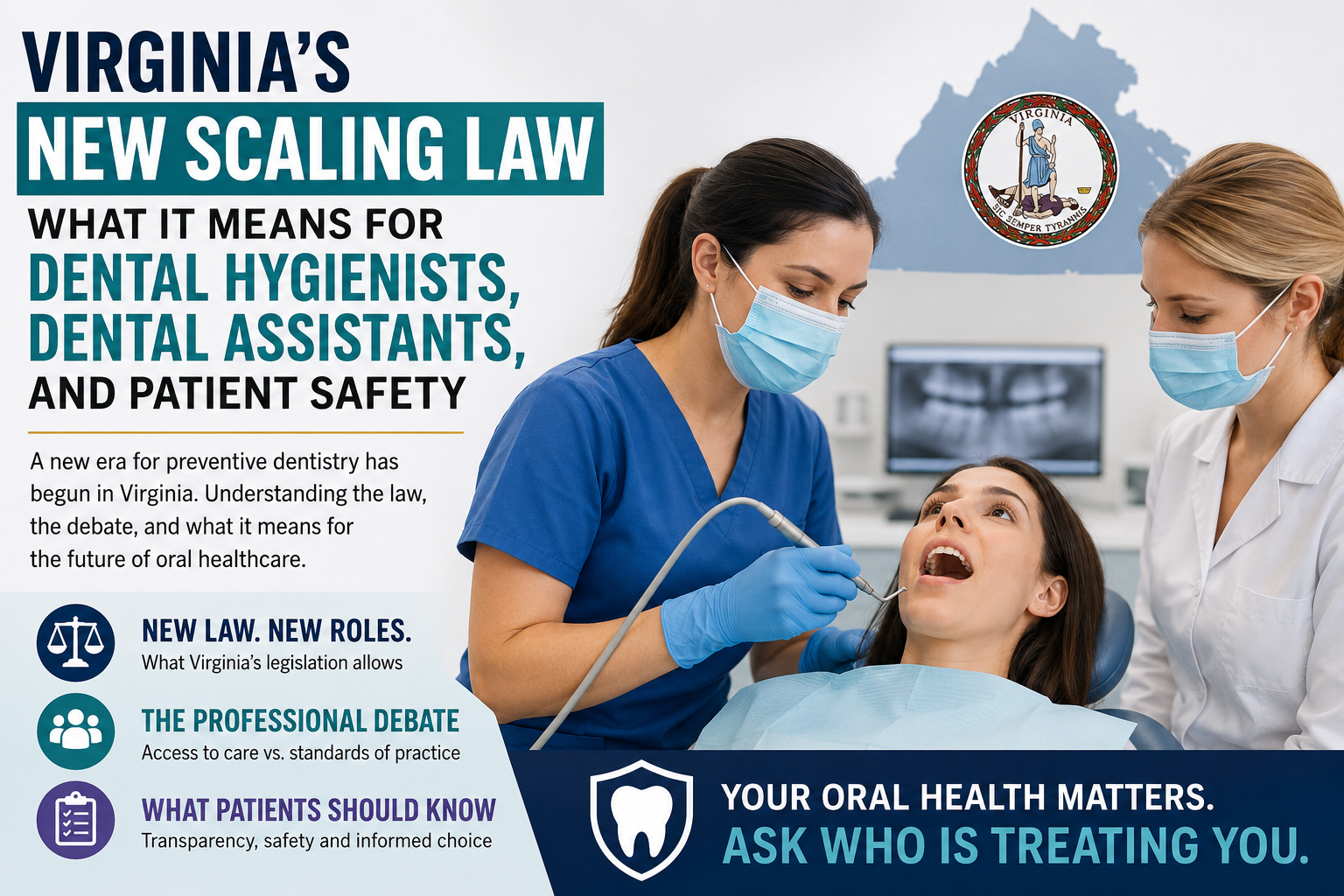
Virginia’s New Scaling Law Sparks a National Conversation About the Future of Preventive Dental Care
As workforce shortages reshape healthcare, Virginia’s decision to expand the role of dental assistants raises an important question: can access to care be improved without compromising professional standards?
For decades, the dental hygiene appointment has been one of the most familiar encounters in oral healthcare. Patients arrive expecting their teeth to be cleaned, their gums assessed, radiographs reviewed when necessary, and any early signs of disease identified before they become significant problems. While the appointment is often perceived simply as “getting a cleaning,” every dental professional understands that it represents far more than the removal of plaque and calculus.
That long-established model entered a new chapter on July 1, 2026, when Virginia enacted legislation permitting specially certified dental assistants to perform supragingival scaling and coronal polishing under the indirect supervision of a licensed dentist. The change has ignited passionate debate throughout the profession, prompting support from many dentists seeking solutions to workforce shortages while drawing equally strong criticism from dental hygienists concerned about patient safety and the future of their profession.
The discussion quickly extended beyond professional circles after a widely shared social media post urged patients to ask whether the individual treating them was a licensed dental hygienist. The post argued that the new law could allow individuals with less formal education to perform procedures traditionally associated with dental hygiene, suggesting that patients should be aware of who is providing their preventive care.
Although emotionally compelling, social media rarely provides the nuance required to understand healthcare legislation. The issue deserves careful examination based on facts rather than rhetoric.
Reading Beyond the Headlines
One of the greatest misconceptions surrounding Virginia’s new legislation is that it allows virtually any dental assistant to perform dental cleanings. That is not what the law says.
The legislation establishes a defined certification pathway for experienced dental assistants wishing to perform limited preventive procedures. Eligibility includes a minimum of 1,800 hours of clinical experience, completion of approved education and competency training, certification requirements, documentation of supervised clinical procedures, and ongoing oversight by a licensed dentist. Before certification, candidates must successfully complete 20 supervised full-mouth supragingival scaling procedures, and a supervising dentist may oversee no more than two certified assistants simultaneously during these procedures.
Equally important is what the legislation does not authorize. Dental assistants are not granted independent practice, nor are they licensed as dental hygienists. The scope of practice remains limited to supragingival scaling and coronal polishing performed under prescribed supervision.
The distinction is significant because much of the public discussion has blurred the difference between expanding delegated duties and replacing an entire profession.
Why Virginia Chose This Path
Virginia’s decision did not emerge in isolation. Across the United States, dental practices have struggled to recruit and retain hygienists following the COVID-19 pandemic. Many practices report extended waiting times for preventive appointments, reduced clinical capacity, and increasing personnel costs. Rural communities and underserved regions have experienced these pressures most acutely.
Faced with these realities, legislators viewed workforce redesign as one potential solution.
The underlying rationale is straightforward. If appropriately trained assistants can safely perform uncomplicated supragingival scaling under a dentist’s supervision, licensed hygienists may devote more time to patients requiring complex periodontal therapy, implant maintenance, comprehensive preventive care, and management of periodontal disease.
This philosophy is hardly unique to dentistry. Healthcare has repeatedly expanded clinical responsibilities among allied professionals. Nurse practitioners, physician assistants, advanced paramedics, expanded-function dental assistants, and dental therapists all emerged from similar efforts to improve access while preserving quality of care.
Supporters therefore argue that Virginia’s legislation represents evolution rather than revolution.
Why Many Hygienists Remain Concerned
Yet the concerns expressed by dental hygienists deserve equal consideration.
The profession has never defined itself solely by the mechanical act of scaling teeth. Modern dental hygiene education encompasses oral pathology, periodontology, anatomy, radiology, pharmacology, infection prevention, patient counselling, risk assessment, and disease recognition. Every routine maintenance appointment serves not only as preventive treatment but also as an opportunity to detect pathology that may otherwise remain unnoticed.
Experienced hygienists routinely identify early periodontal breakdown, suspicious mucosal lesions, defective restorations, peri-implant disease, occlusal trauma, gingival recession, xerostomia, medication-related oral changes, and numerous systemic manifestations that first appear within the oral cavity.
These diagnostic observations often determine whether a patient receives timely intervention or progresses toward more advanced disease.
Consequently, critics argue that reducing preventive dentistry to instrumentation alone overlooks the broader clinical purpose of the dental hygiene appointment.
Their concern is not simply who removes calculus.
It is who recognises disease.
Can Instrumentation Ever Be Separated from Clinical Judgment?
This question lies at the heart of the debate.
Supragingival scaling is unquestionably a technical procedure. However, deciding whether deposits are confined above the gingival margin, recognising early attachment loss, distinguishing gingivitis from periodontitis, identifying patients requiring periodontal therapy, or recognising lesions warranting further investigation all require clinical judgement developed through extensive education and experience.
Modern dentistry increasingly recognises that diagnosis and treatment are inseparable components of quality care.
Even patients attending for routine maintenance may present with subtle findings that alter treatment planning. Mild inflammation may conceal early periodontal destruction. Slight tissue changes may represent the earliest manifestations of oral potentially malignant disorders. Seemingly routine appointments frequently become opportunities for life-changing diagnosis.
This reality explains why many hygienists believe preventive appointments cannot be viewed simply as technical procedures.
The Missing Piece: Evidence
Perhaps the most important observation is that neither side currently possesses definitive evidence supporting its position.
Because Virginia’s legislation only came into effect in July 2026, there are no long-term clinical outcome studies evaluating its impact on patient safety, periodontal health, diagnostic accuracy, patient satisfaction, or access to care.
Both optimism and concern therefore remain largely predictive.
Healthcare history offers numerous examples where expanded scopes of practice proved highly successful, as well as others requiring substantial revision following implementation. The determining factor has consistently been robust education, competency assessment, ongoing quality assurance, and continuous outcome monitoring.
Virginia now has an opportunity to contribute meaningful evidence to a debate likely to influence dental workforce policy across the United States.
Future research should evaluate not only procedural outcomes but also diagnostic accuracy, referral patterns, patient satisfaction, healthcare costs, access to preventive care, and long-term periodontal health.
Only objective data—not professional opinion—can determine whether the legislation achieves its intended goals.
Patients Should Never Have to Guess
Amid the professional debate, one principle remains beyond dispute: patients have the right to know who is providing their care.
Transparency is a cornerstone of informed consent and strengthens public trust in healthcare.
Whether treatment is delivered by a dentist, dental hygienist, or certified dental assistant, patients should feel comfortable asking about the qualifications of the individual performing their procedure and understanding the role each member of the dental team plays in their care.
Such conversations should foster confidence rather than anxiety.
Healthcare functions best when patients are informed participants rather than passive recipients.
A Debate That Will Extend Well Beyond Virginia
Virginia’s legislation may ultimately be remembered as either a successful model for improving access to preventive dentistry or as a cautionary example highlighting the importance of preserving professional boundaries. At present, neither conclusion is justified.
What is clear, however, is that dentistry is confronting the same workforce challenges already experienced throughout healthcare. As populations age, demand for care increases, and workforce shortages persist, governments will continue exploring innovative models of care delivery.
The success of these initiatives will depend less on expanding scopes of practice than on ensuring that every expansion is accompanied by rigorous education, competency-based certification, effective supervision, and transparent evaluation.
Dental assistants remain indispensable members of every successful dental practice. Licensed dental hygienists continue to provide a unique depth of preventive expertise developed through formal education and clinical training. These realities are not mutually exclusive.
The profession’s challenge is not deciding which group is more valuable.
It is determining how every member of the dental team can contribute to improving patient care while maintaining the highest standards of safety, quality, and public trust.
Ultimately, the verdict on Virginia’s new law will not be delivered through legislative chambers or social media debates.
It will be written in the health of the patients it was designed to serve.
Editor’s Note: This article is an independent evidence-based analysis of Virginia’s workforce legislation. It does not advocate for or against the expanded role of dental assistants but encourages continued evaluation through high-quality clinical research, transparent regulation, and patient-centered outcomes.