
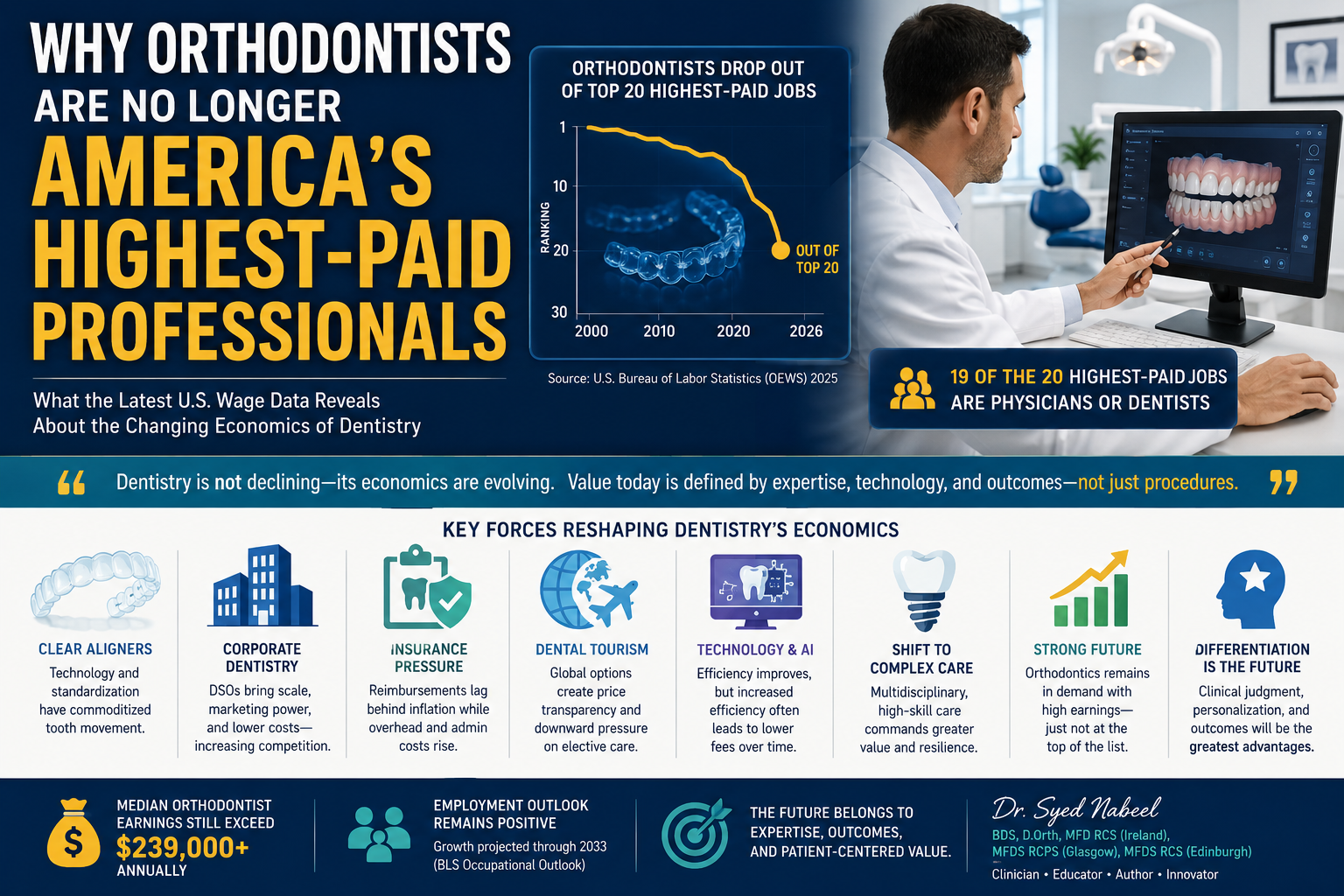
What the latest U.S. federal wage data may be telling us about the changing economics of dentistry.
For nearly three decades, orthodontists occupied an almost mythical position in American salary rankings. Year after year, lists published by CNN, Forbes, and other media outlets—largely derived from U.S. Bureau of Labor Statistics (BLS) data—placed orthodontists among, and frequently at the very top of, America’s highest-paid professions.
The latest federal wage analysis, highlighted by USA Today, tells a different story.
Orthodontists have disappeared from the nation’s top twenty highest-paying occupations. Even more striking, general dentistry itself has slipped substantially in relative ranking, while medical and surgical specialties now dominate almost every position on the list. Nineteen of the twenty highest-paying occupations are physicians or dentists, yet dentistry’s historical dominance has clearly weakened.
This is not merely a change in statistics.
It is a reflection of a profession undergoing one of the most profound economic transformations in its modern history.
A profession that became a market
Unlike medicine, much of dentistry in the United States has traditionally operated as a small-business enterprise.
Clinical excellence alone was often sufficient to generate sustainable practice growth.
That equation has fundamentally changed.
Orthodontics, perhaps more than any other dental specialty, has witnessed the convergence of multiple disruptive forces.
The introduction and maturation of clear aligner therapy transformed orthodontic treatment from a highly specialized service into one that, for many straightforward cases, became increasingly commoditized. Digital workflows, remote monitoring, and direct-to-consumer marketing altered patient expectations and lowered perceived barriers to entry.
The result was not the disappearance of orthodontics—but the democratization of tooth movement.
As procedures become more standardized and digitally guided, economic premiums naturally diminish.
Corporate dentistry has rewritten pricing dynamics
During the same period, corporate Dental Service Organizations (DSOs) expanded at unprecedented speed.
Large organizations possess purchasing power, centralized marketing, sophisticated financing models, and operational efficiencies that are simply unavailable to traditional solo practices.
Competition therefore shifted.
Dentists were no longer competing solely on clinical reputation.
They increasingly competed on financing options, advertising reach, convenience, extended office hours, subscription plans, and negotiated insurance contracts.
In classical economic terms, dentistry evolved from a predominantly provider-driven market toward a consumer-driven marketplace.
Margins inevitably narrowed.
The invisible pressure of insurance
Although Americans continue to spend more per capita on dental care than most populations globally, much of that expenditure does not translate proportionately into clinician income.
Administrative costs have risen.
Insurance reimbursement has failed to keep pace with inflation in many regions.
Practice overhead—including staffing, technology, compliance, cybersecurity, and real estate—has increased substantially.
Consequently, gross expenditure on dentistry should not be confused with net professional earnings.
Higher national spending does not necessarily produce higher individual dentist income.
Dental tourism: a global price correction
Another force rarely discussed in wage analyses is globalization.
High-cost restorative and cosmetic procedures increasingly compete with internationally accredited centers in countries such as Mexico, Costa Rica, Colombia, Turkey, Hungary, Thailand, and India.
Patients who once accepted domestic pricing now compare treatment packages internationally.
Digital consultations, online reviews, and affordable international travel have reduced informational asymmetry.
Even if dental tourism represents only a fraction of total U.S. treatment volume, it exerts downward competitive pressure on elective procedures—the very procedures that historically generated substantial practice profitability.
Technology creates efficiency—but rarely preserves scarcity
Innovation has always improved patient care.
Yet innovation also alters economics.
Digital scanners, AI-assisted treatment planning, CAD/CAM restorations, guided implant surgery, and aligner software have dramatically increased efficiency.
Ironically, greater efficiency often compresses fees over time.
What was once technically rare gradually becomes commercially routine.
Economists describe this as the erosion of scarcity premiums.
Healthcare is not immune.
Is orthodontics declining?
Absolutely not.
Demand for orthodontic care remains robust.
Employment projections remain positive, and orthodontists continue to earn among the highest incomes within dentistry. Median earnings remain well above $239,000 annually, with many private practitioners substantially exceeding national medians.
The issue is relative—not absolute.
Orthodontists remain exceptionally well compensated.
They simply no longer occupy the extraordinary economic position they once held relative to other professions.
The future belongs to differentiation
Perhaps the most important lesson from the latest federal wage data is this:
Routine dentistry is becoming increasingly standardized.
Complex dentistry is becoming increasingly valuable.
Practices centered on multidisciplinary rehabilitation, craniofacial care, implant reconstruction, airway-focused orthodontics, digital integration, facial aesthetics, and comprehensive interdisciplinary treatment are likely to command greater economic resilience than practices competing primarily on commodity procedures.
Clinical judgment—not merely technical execution—may become the profession’s greatest competitive advantage.
Beyond income rankings
Salary rankings are seductive because they simplify success into a single number.
Yet they conceal important realities.
A profession should ultimately be judged not only by annual earnings, but by autonomy, societal impact, scientific innovation, professional satisfaction, and the ability to improve lives.
Orthodontics has not lost its relevance.
Rather, it has entered a new economic era—one in which value is increasingly determined not by the procedure itself, but by expertise, personalization, and outcomes that technology alone cannot replicate.
Editorial note: Several interpretations in this analysis—particularly regarding the effects of clear aligners, corporate DSOs, insurance reimbursement, and dental tourism—are informed inferences based on well-documented industry trends rather than direct findings from the BLS wage report itself. The federal wage data identify what changed in compensation rankings; the broader market explanations represent a synthesis of contemporary evidence and economic reasoning rather than a demonstrated causal conclusion.

Author: Dr. Syed Nabeel
BDS, D.Orth, MFD RCS (Ireland), MFDS RCPS (Glasgow), MFDS RCS (Edinburgh)
Dr. Syed Nabeel is a clinician–scholar with over two decades of experience spanning orthodontics, neuromuscular dentistry, and digitally integrated diagnostics. As Clinical Director of Smile Maker Clinics Pvt. Ltd., he combines anatomical precision, occlusal science, and contemporary AI-enabled workflows in clinical care.
Founder of DentistryUnited.com (2004), he has built a professional community connecting over 40,000 dental professionals worldwide. He also founded Dental Follicle – The E-Journal of Dentistry (ISSN 2230-9489), an EBSCO-indexed peer-reviewed platform promoting interdisciplinary dental scholarship.
An educator, speaker, and advocate of collaborative learning, Dr. Nabeel continues to contribute through clinical practice, research, mentorship, and innovation—guided by the belief that knowledge creates greater value when shared.
⸻
References
1. USA Today. “The 20 highest-paying jobs in America? Doctors, doctors, more doctors.” July 2026.
2. U.S. Bureau of Labor Statistics. Occupational Outlook Handbook: Dentists. Updated 2025.
3. U.S. Bureau of Labor Statistics. Occupational Employment and Wage Statistics (OEWS), 2025 wage estimates.