
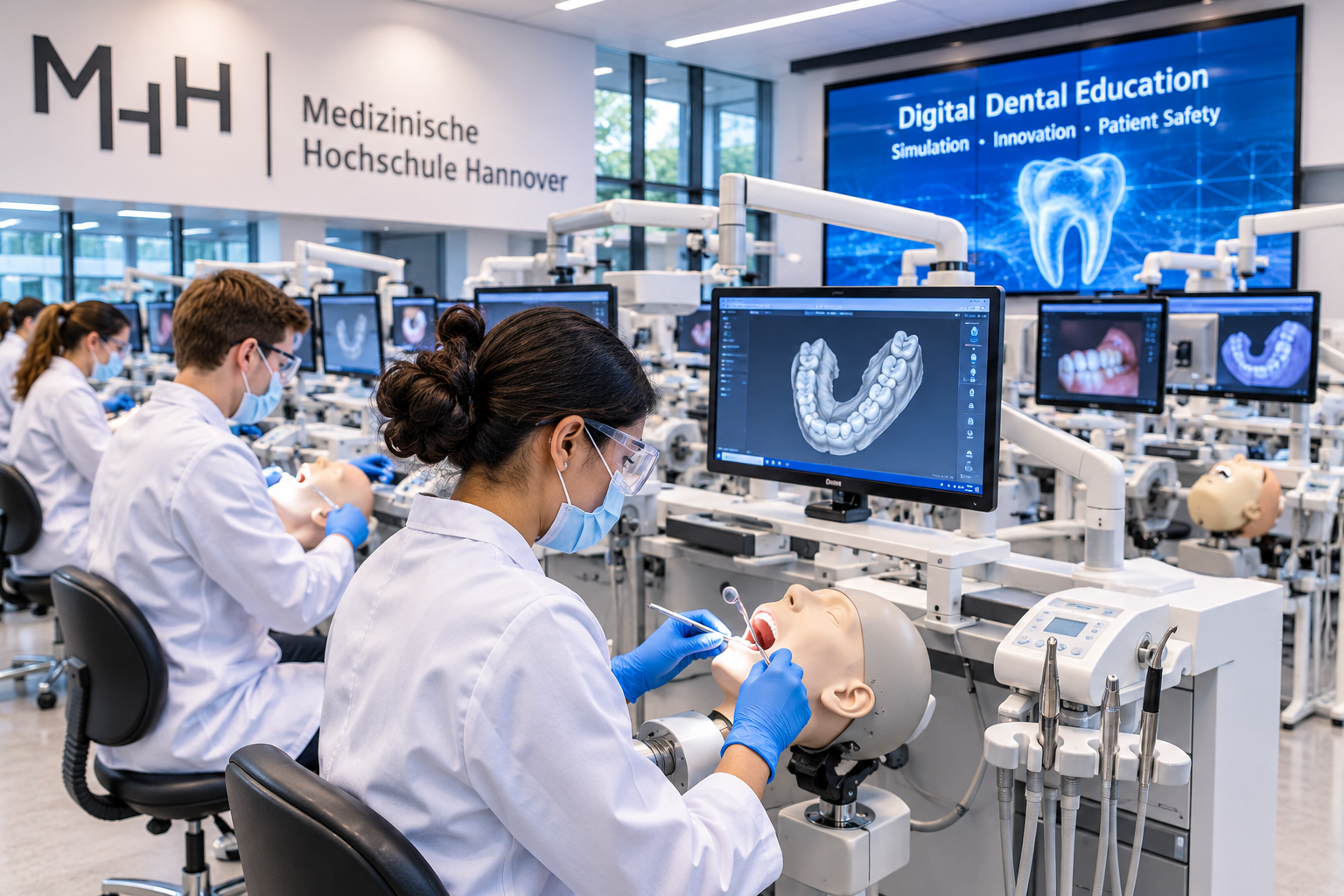
The Future of Dental Education: Hannover Medical School Opens Advanced Digital Simulation Laboratories
An international perspective on the changing architecture of dental education
There was a time when the phantom head, a dental handpiece and a collection of extracted teeth represented the principal vocabulary of preclinical dental education. Generations of dentists acquired their foundational clinical skills in these laboratories, learning the delicate relationship between vision, touch, instrument control and the anatomy of the tooth.
That model is now undergoing a significant transformation.
The Hannover Medical School (Medizinische Hochschule Hannover, MHH) in Germany has officially inaugurated its second state-of-the-art dental simulation laboratory, bringing the institution’s total capacity to 92 digitally connected simulation units across two dedicated learning facilities.
The development, announced on 3 November 2026, represents a substantial investment in the future of dental education, with the State of Lower Saxony committing more than €13 million to the project.
But the real story lies beyond the impressive infrastructure. It is about redefining how future dentists acquire, practise, understand and integrate clinical skills before they begin treating patients.
Beyond the Phantom Head: The Emergence of the Digital Dental Laboratory
At the centre of the new facilities are digitally equipped phantom-head simulation units. These are not merely upgraded workstations where students practise cavity preparations or crown preparations.
They form part of an interconnected educational ecosystem.
The simulation laboratories allow demonstrations to be transmitted simultaneously to multiple workstations through an integrated network. Microscopes, cameras and computer systems facilitate faculty-led demonstrations, enabling students to observe procedures from different perspectives without being restricted to the limitations of conventional classroom teaching.
The educational possibilities extend further.
Students can undertake simulated treatment exercises based on individual patient cases created using intraoral scan data. This introduces them to virtual clinical scenarios in which they can rehearse procedures and develop familiarity with treatment challenges before encountering them in actual clinical practice.
Even complex procedures, including endodontic treatment, can be incorporated into this resource-efficient simulation environment.
The distinction is important: students are no longer simply learning how to operate dental instruments. They are learning to think through clinical procedures in an environment that increasingly resembles the digital reality of contemporary dentistry.
From Tooth Preparation to a Finished Restoration: Teaching the Complete Digital Workflow
Perhaps the most interesting aspect of the Hannover initiative is its integration of the complete digital prosthodontic workflow into undergraduate dental education.
Consider the preparation of a tooth for a crown or bridge.
Students begin by performing the clinical preparation on the phantom head. They subsequently capture the prepared tooth using an intraoral scanner. The acquired digital information is then transferred to computer-aided design software, where the dental restoration is designed.
The restoration is subsequently manufactured through computer-aided manufacturing, using a milling process. Finally, students can place the restoration they have designed and fabricated onto the phantom head itself.
In other words, the student experiences the entire journey:
Clinical preparation → Intraoral scanning → Digital impression → CAD design → CAM manufacturing → Final restoration.
This is a particularly meaningful development.
Digital dentistry is often introduced to students as a collection of technologies: scanners, software, milling machines and computer-based systems. Hannover’s approach brings these components together as a continuous clinical workflow.
It teaches students not merely to operate digital equipment, but to understand how one stage of treatment informs and influences the next.
That distinction could become increasingly important as digital workflows become integral to restorative dentistry, prosthodontics, implantology and orthodontics.
Education, Technology and Patient Safety: The Bigger Picture
The investment also reflects a broader philosophy of clinical education.
Students must have the opportunity to make mistakes, understand their consequences, refine their technique and repeat procedures without exposing patients to unnecessary risk.
Simulation-based learning provides precisely this opportunity.
MHH President Professor Denise Hilfiker-Kleiner emphasised that the new laboratories would allow students to practise complex procedures under realistic conditions before assuming responsibility for patients.
This is not merely an infrastructure upgrade. It is an investment in patient safety through better preparation of future clinicians.
The laboratories are also designed to accommodate changes in Germany’s revised Dental Licensing Regulations (ZApprO), which have introduced a three-phase structure for dental education instead of the earlier two-phase arrangement.
The resulting requirements include more small-group teaching, revised examination formats and lower student-to-instructor ratios. Expanding simulation capacity has therefore become an academic necessity as much as a technological ambition.
A Laboratory That Has Evolved With Its Time
There is an interesting historical dimension to this development.
The previous phantom-course laboratory at Hannover had been in operation since 1993. After more than three decades of service, renovation and expansion became necessary.
The new facilities were delivered through a construction project lasting approximately one and a half years. The first simulation laboratory was completed in August 2025, followed by the official opening of the second facility in November 2026.
Importantly, the construction was undertaken while the university continued its operations and was completed on schedule and within budget.
At the inauguration, Lower Saxony’s Minister of Science, Falko Mohrs, even took a seat at one of the new phantom-head units, receiving guidance from the university’s academic leadership.
It was a symbolic gesture, but one that captured the spirit of the occasion: the future of dentistry depends on bringing science, practical experience and technology into the same learning environment.
The Question for Dental Education in India
Developments such as this should prompt an important conversation among Indian dental educators, institutional leaders and policymakers.
How many of our dental institutions are preparing students for the actual technological environment they will encounter in contemporary practice?
We have made considerable progress in acquiring intraoral scanners, CAD/CAM systems, digital radiography, implant-planning software and orthodontic technologies. However, the presence of sophisticated equipment in a dental institution does not automatically translate into sophisticated education.
The real challenge is curricular integration.
Can an undergraduate student understand the complete digital restorative workflow before graduation? Can students practise scanning, evaluate digital impressions, understand the principles of CAD design and appreciate the manufacturing process? Can simulation laboratories become environments for developing clinical judgement rather than simply fulfilling practical examination requirements?
These are questions worth asking.
The future dental graduate will need more than competent hands. They will need digital literacy, clinical reasoning, technological adaptability and the ability to move seamlessly between conventional and digital approaches to patient care.
The Future Is Not About Replacing the Phantom Head
It would be simplistic to suggest that digital technology will replace conventional preclinical training. It will not.
The future lies in combining the strengths of traditional hands-on education with the possibilities offered by digital simulation.
The phantom head remains relevant. The handpiece remains relevant. Tactile sensitivity, anatomical understanding and clinical judgement remain indispensable.
What changes is the educational environment surrounding them.
Hannover Medical School has demonstrated what becomes possible when infrastructure, curriculum, technology and patient-safety objectives are conceived as parts of one integrated educational strategy.
The next generation of dentists will not simply learn dentistry and subsequently discover digital technology. They will learn dentistry in an environment where digital technology is already part of the language of clinical practice.
And perhaps that is the most important lesson from Hannover.
The dental college of tomorrow will not be distinguished merely by the number of dental chairs it owns, the size of its building or the equipment displayed in its corridors.
It will be distinguished by how intelligently it prepares its students for the dentistry that lies ahead.
Source: Medizinische Hochschule Hannover (MHH), “New simulation rooms for dentistry education”, published 3 November 2026. This report is an independent editorial interpretation of the institution’s announcement.
Original announcement: Medizinische Hochschule Hannover – New simulation rooms for dentistry education.