In 2007, a patient came into my clinic for a full-mouth rehabilitation.
He was panting when he entered.
Before I could think about his teeth, I had to think about the person sitting in the dental chair.
I asked for his medical history.
He produced a file.
It was not a dental file.
It was, in effect, a compressed biography of his interaction with modern medicine: consultations with cardiologists, pulmonologists, surgeons, dermatologists, endocrinologists and other specialists; laboratory investigations; biochemical reports; medications; allergies; previous diagnoses; and, importantly, his most recent ECG.
I had to read it.
I had to interpret it.
And where the implications exceeded my competence, I had to depend upon the cardiologist—or another medical specialist—to help establish whether dental treatment could safely proceed.
Only after that came dentistry.
Extractions.
Root canal treatment.
Periodontal surgery.
Restorations.
Crowns.
Bridges.
Implants.
A full-mouth rehabilitation is never merely a sequence of dental procedures. It is a chain of clinical decisions in which one decision changes the risk profile of the next.
If something went wrong, I could not simply look at the tooth.
I had to go back.
Back to the history.
Back to the medications.
Back to the systemic disease.
Back to the laboratory findings.
Back to the cardiology opinion.
Back to the diagnosis.
The patient’s mouth was not an isolated anatomical territory. It was connected to the rest of the human being.
And that, perhaps, was the first lesson of the coming revolution.
The problem was never that dentists lacked information. The problem was that no human being could process all of it quickly enough.
The cognitive burden of dentistry
For generations, dental education was constructed around a remarkably logical premise:
Learn. Remember. Analyse. Diagnose. Treat.
We learned anatomy.
Physiology.
Pathology.
Pharmacology.
Microbiology.
Radiology.
Periodontology.
Endodontics.
Prosthodontics.
Oral surgery.
Orthodontics.
Then we were expected to bring all of those domains together when a real patient appeared in front of us.
That model worked because the volume of clinically relevant information available to a dentist was finite enough to remain cognitively manageable.
But medicine did not remain finite.
Neither did dentistry.
The scientific literature expanded exponentially. Diagnostic modalities multiplied. Molecular biology entered clinical medicine. Genomics appeared. Digital imaging became ubiquitous. Electronic health records accumulated longitudinal data. Dental CBCT generated three-dimensional information. Intraoral scanners transformed physical anatomy into digital datasets.
And somewhere along the way, the dentist became responsible for navigating an information environment that was larger than any individual human memory could comfortably contain.
The traditional dental curriculum, however, largely remained designed for the dentist of the previous information age.
That is the paradox.
We are training students to become excellent readers of information at precisely the moment when machines are becoming extraordinarily good at reading information.
Then came 2020
The year 2020 changed more than our behaviour.
It changed our perception of what machines could do.
GPT-3 was released in 2020, demonstrating a striking new capability of large language models: the ability to process and generate remarkably sophisticated human language at scale.
The significance for healthcare was not that a machine had suddenly become a dentist.
It was something more subtle.
A machine could begin to read, organise, summarise and synthesize enormous quantities of information in a manner that felt qualitatively different from conventional software.
That distinction matters.
For decades, computers were excellent at calculation.
Now they were becoming increasingly capable of working with language, patterns and knowledge.
The distance between:
“Here is the patient’s medical record.”
and
“Here is what matters in this record for today’s dental procedure.”
began to shrink.
And suddenly, the patient who walked into my clinic in 2007 became a useful thought experiment for the dentistry of 2026.
Imagine that patient walking into the clinic today
Imagine the same patient entering a technologically mature dental practice today.
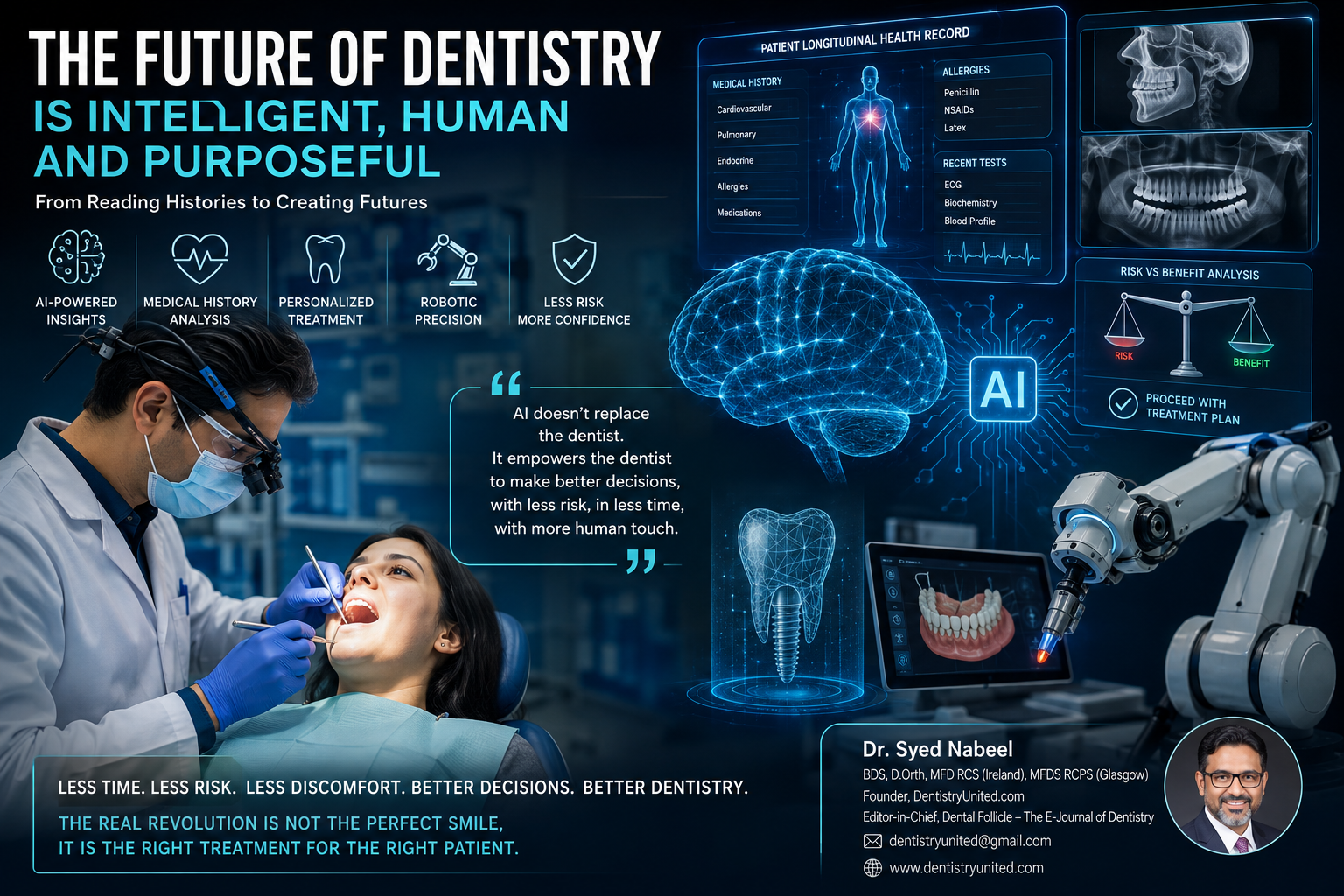
Instead of placing a thick medical file on the desk, he authorizes access to his longitudinal health record.
The system retrieves his relevant clinical information through secure, consent-based interoperability.
His identity is verified.
His allergies appear.
His medications appear.
His cardiovascular history appears.
His pulmonary history appears.
His relevant laboratory results are organised chronologically.
Previous procedures are identified.
Potential drug interactions are flagged.
Relevant medical risks are prioritised.
His previous dental treatment is incorporated.
Radiographs and CBCT data can be analysed alongside the clinical record.
The system does not simply say:
“This patient has a history of cardiac disease.”
It can potentially ask a much more useful question:
“What does this patient’s current medical status mean for the procedure you are about to perform?”
That is a fundamentally different kind of clinical technology.
It is not merely electronic record keeping.
It is clinical intelligence augmentation.
From identity to intelligence
There is an important caveat.
The future should not be imagined as a dentist typing an Aadhaar number into an AI system and receiving a medical history.
That would create enormous privacy, cybersecurity and governance problems.
A more credible future is one in which a patient’s identity provides access—under explicit consent and appropriate governance—to a secure, interoperable longitudinal health record.
The identifier opens the door.
It should not become the medical record itself.
The distinction is critical.
WHO has emphasised that AI in health must be developed and deployed with safety, ethics, equity, governance and appropriate regulation. (World Health Organization)
The future therefore is not:
Identity → AI → treatment.
It is:
Patient → consent → interoperable data → validated AI → clinician → treatment.
The dentist remains accountable.
The machine becomes extraordinarily useful.
What happens when AI reads the literature too?
There is another problem that is even larger.
A dentist cannot read everything.
No dentist can.
No professor can.
No dental school can.
The contemporary evidence base is simply too large and too dynamic.
One recent scoping review of AI in dental education identified 547 studies initially, with only 17 meeting its inclusion criteria—an illustration of both the enormous volume of emerging literature and the difficulty of determining what is actually relevant. (PubMed)
Another review of AI and immersive technologies in dental education began with 2,500 articles, of which 31 met its inclusion criteria. (PubMed)
The question therefore changes.
The future dentist does not need to memorise the entire scientific literature.
But the future dentist must be able to interrogate it.
That is a different competency.
Imagine asking an AI system:
“For a 58-year-old patient with these systemic conditions, these medications, these allergies, this periodontal status, this bone morphology and this proposed treatment plan, what does the current evidence suggest about the risks, benefits, alternatives and sequencing of treatment?”
That is not a Google search.
It is not merely ChatGPT.
It is the beginning of patient-specific evidence synthesis.
And that could become one of the most important transformations in clinical dentistry.
Dentistry could move from evidence-based to evidence-computing
Evidence-based dentistry traditionally requires the clinician to formulate a question, search the literature, evaluate evidence, interpret applicability and integrate it with clinical expertise and patient preferences.
That process remains indispensable.
But AI could compress the information-retrieval component dramatically.
Instead of asking:
“What does the literature say about this procedure?”
the dentist could eventually ask:
“What does the literature say about this procedure in a patient who resembles the patient sitting in front of me?”
That distinction takes dentistry toward something closer to precision clinical decision-making.
The machine searches.
The machine compares.
The machine synthesizes.
The machine identifies patterns.
The dentist decides.
The patient participates.
And then comes the robot
AI is only one half of the transformation.
The other is embodiment.
For years, digital dentistry has been converting the patient’s anatomy into data.
Intraoral scanners create digital impressions.
CBCT creates volumetric anatomy.
Digital photography captures soft-tissue information.
CAD/CAM converts designs into manufacturable objects.
Navigation systems translate digital plans into physical trajectories.
Robotics can potentially execute increasingly precise movements under human supervision.
The logical trajectory is therefore not:
AI replaces dentist.
It is:
AI + digital data + robotics + human judgement.
The computer may recognize.
The robot may execute.
But the clinician must understand what should—and should not—be done.
The perfect smile is not the real destination
This is where the conversation about artificial intelligence in dentistry often becomes superficial.
We talk about AI designing a more symmetrical smile.
Predicting tooth movement.
Detecting caries.
Reading radiographs.
Designing implants.
Generating crowns.
All of these are important.
But they are not the deepest opportunity.
The deepest opportunity is better care with less unnecessary burden.
Perhaps the future of dentistry should not be measured primarily by how perfect a smile becomes.
It should be measured by:
less time,
less risk,
less discomfort,
fewer avoidable complications,
fewer unnecessary procedures,
better sequencing,
better communication,
and better decisions.
The perfect restoration is valuable.
The right treatment at the right time for the right patient is far more valuable.
This is where dental schools face an uncomfortable question
If AI can retrieve information, summarise medical histories, interpret images, compare treatment alternatives, synthesise research and provide decision support, what exactly should a dental student spend five years learning?
The answer is not:
“Less dentistry.”
It is:
“Different dentistry.”
Students still need anatomy because AI does not make anatomy irrelevant.
They need pathology because pattern recognition without biological understanding is dangerous.
They need pharmacology because a machine-generated recommendation does not remove professional responsibility.
They need clinical skills because no algorithm can eliminate the physical reality of a patient.
They need ethics because technology without ethics can amplify harm.
They need communication because patients do not experience healthcare as a dataset.
And above all, they need clinical reasoning.
But the educational emphasis must change.
From memorization to interrogation
The dental student of the future should be able to ask:
What is the diagnosis?
But also:
What data supports the diagnosis?
What data is missing?
How reliable is the AI’s conclusion?
What is the reference standard?
What is the sensitivity?
What is the specificity?
What is the positive predictive value in this population?
Was the model externally validated?
Does it generalise to my patient?
Could demographic or institutional bias influence its performance?
What happens when the AI is wrong?
This is not computer science replacing dentistry.
It is dentistry becoming sufficiently sophisticated to interrogate computer science.
A proposed core curriculum for AI in oral healthcare has already identified competencies including machine-learning fundamentals, training and validation, reference standards, explainability, evaluation metrics, generalisability, representativeness, autonomy, accountability and governance. (PubMed)
That is precisely the direction dental education should take.
The new dental curriculum
Imagine a dental curriculum built around five layers.
Layer 1 — Biological intelligence
Anatomy, physiology, pathology, pharmacology, microbiology and the biological sciences.
The foundation remains.
Layer 2 — Clinical intelligence
Diagnosis, differential diagnosis, treatment planning, risk assessment, sequencing and patient-centred care.
The dentist learns to reason.
Layer 3 — Data intelligence
Electronic health records, digital imaging, longitudinal datasets, interoperability, statistics, machine learning and clinical decision-support systems.
The dentist learns to understand data.
Layer 4 — Artificial intelligence literacy
Model validation.
Bias.
Hallucination.
Explainability.
Sensitivity and specificity.
Calibration.
External validation.
Human oversight.
Privacy.
Cybersecurity.
Regulation.
The dentist learns when not to trust the machine.
Layer 5 — Human intelligence
Empathy.
Communication.
Ethics.
Shared decision-making.
Leadership.
Judgement.
Responsibility.
Because the more intelligent our machines become, the more valuable these human capabilities may become.
The evidence is already beginning to move
This is no longer merely a futuristic argument.
A 2026 systematic review examined AI-driven simulation in dental education and evaluated its effect on learning outcomes. (PubMed)
Another 2026 systematic review examined deep machine learning in dental education, including its use in teaching and diagnostic tasks. (PubMed)
Recent reviews are also examining AI in dental assessment, preclinical training, diagnostic education and personalised learning. (PubMed)
Meanwhile, professional organisations are moving from discussing AI as an emerging curiosity to developing standards for its evaluation. The American Dental Association has published standards addressing AI image-analysis validation and evaluation, including the importance of independent datasets and appropriate validation. (Ada Engineers)
And the adoption curve is no longer theoretical: a 2026 ADA survey reported that 43.3% of responding U.S. dentists were using AI for at least one task, while 22.8% reported using AI for imaging and diagnostics. (Ada Engineers)
The question is therefore no longer:
“Will AI enter dentistry?”
It already has.
The more consequential question is:
“Will dental education adapt quickly enough?”
The greatest danger may not be AI
There is a paradox here.
The greatest danger may not be that artificial intelligence becomes too powerful.
It may be that dental schools become too slow.
A student who graduates in 2030 will enter a clinical environment profoundly different from the one in which many of today’s curricula were designed.
If the curriculum teaches only how to retrieve information, while machines increasingly retrieve and synthesize information better, we will have trained graduates for yesterday.
If the curriculum teaches students how to question information, validate evidence, understand uncertainty, integrate biology, assess risk and make accountable decisions, then AI becomes an extraordinary educational amplifier.
The difference is enormous.
The dentist of 2035
Perhaps the dentist of 2035 will begin a consultation differently.
The patient sits down.
The system has already reviewed the available history.
It has identified allergies.
It has checked medications.
It has analyzed relevant laboratory trends.
It has flagged cardiovascular and systemic considerations.
Radiographs have been pre-screened.
The patient’s previous dentistry has been reconstructed.
The current scientific literature has been searched.
Several treatment strategies have been modelled.
Risks and benefits have been estimated.
Possible complications have been identified.
The dentist does not walk into the room knowing everything.
The dentist walks into the room knowing what matters.
That may be the real revolution.
We are not teaching dentists to compete with machines
There is a recurring fear that AI will replace dentists.
I suspect the more realistic scenario is different.
Dentists who use AI will increasingly work differently from dentists who do not.
The profession may divide not into:
human versus machine,
but into:
human alone versus human augmented by intelligence.
The dentist remains the person responsible for the patient.
The machine becomes the tireless assistant that never gets bored reading a 300-page medical record, never complains about reviewing another systematic review, never forgets that an allergy appeared five years ago, and can compare thousands of relevant pieces of evidence in seconds.
But it also makes mistakes.
And therefore the dentist must remain intellectually stronger than the tool.
The lesson of that patient in 2007
I still return to that patient.
He entered the clinic panting.
His medical history filled a file.
I had to read it.
I had to interpret it.
I had to decide whether I could safely proceed.
And when treatment became complicated, I had to return repeatedly to the information contained in those pages.
In 2007, that was simply what being a conscientious dentist meant.
Today, that same clinical problem offers us a glimpse into the future.
The file could become a structured longitudinal dataset.
The dataset could become a clinical summary.
The summary could become a risk model.
The risk model could interact with the dental record.
The dental record could interact with imaging.
The imaging could interact with treatment planning.
The treatment plan could interact with robotics.
And the entire system could continuously learn from the world’s accumulating scientific knowledge—subject to validation, governance and human oversight.
That is not science fiction.
The pieces already exist.
What remains is to integrate them responsibly.
The real reinvention of dental education
For a century, dental schools largely taught students to become repositories of knowledge.
Then they taught them to become users of evidence.
The next generation must learn to become orchestrators of intelligence.
That does not mean teaching less science.
It means teaching science at a deeper level.
It means moving from:
“Remember this.”
to:
“Understand this.”
From:
“Find this paper.”
to:
“Critically evaluate this evidence.”
From:
“Make this diagnosis.”
to:
“Explain why this diagnosis is defensible—and when it might be wrong.”
From:
“Follow this protocol.”
to:
“Know when the protocol does not fit the patient.”
And ultimately from:
“Treat the tooth.”
to:
“Treat the human being, using every reliable source of intelligence available.”
The future dental school may look less like a library—and more like a cockpit
Perhaps this is the metaphor we need.
A modern aircraft does not eliminate the pilot because computers became sophisticated.
It gives the pilot more information, better navigation, predictive systems and increasingly powerful automation.
But the pilot must understand the aircraft deeply enough to recognize when the system is wrong.
The future dental clinic may be similar.
The dentist will sit at the centre of a clinical intelligence environment containing the patient record, imaging, laboratory data, evidence, simulation, prediction and potentially robotic execution.
The dentist will not know everything.
No human can.
But the dentist will know how to ask, how to verify, how to interpret and how to decide.
That is a very different educational philosophy.
And perhaps that is the real challenge before dental schools today.
AI is not asking us to teach fewer dentists.
It is asking us to decide what a dentist should know when a machine can know almost everything else.
The answer will determine whether dental education merely survives the AI revolution—or leads it.
The final question
The patient who walked into my clinic in 2007 brought me a file.
The patient of the future may bring something far more powerful:
a living, longitudinal, continuously updated model of his or her health.
Our responsibility will not be to surrender judgement to that model.
It will be to become capable of using it.
Because the ultimate promise of artificial intelligence in dentistry is not a machine that makes the perfect crown.
It is a healthcare system in which the dentist spends less time searching through information—and more time understanding the person sitting in the chair.
Less time.
Less risk.
Less discomfort.
Better decisions.
Better dentistry.
And perhaps, after more than a century of teaching dentists how to acquire knowledge, it is finally time for dental schools to teach them how to command intelligence.
Author:
Dr. Syed Nabeel, BDS, D.Orth, MFD RCS (Ireland), MFDS RCPS (Glasgow) MFDS RCS(Edinburgh) is a clinician, educator, writer and dental technology enthusiast whose professional journey has increasingly occupied the space where clinical dentistry, evidence, digital technology and artificial intelligence intersect.
Practising dentistry since 2002, he is the Founder of DentistryUnited.com, established in 2004 with a simple but unconventional idea for its time: that dental knowledge should not be confined by geography, institutions or professional boundaries. What began as a small digital initiative from a dental clinic in Mysore grew into an international professional community connecting dentists and dental professionals across the world.
In 2006, he founded Dental Follicle – The E-Journal of Dentistry (ISSN 2230-9489), continuing his commitment to creating spaces where clinicians could exchange ideas, discuss evidence and engage with emerging developments in dentistry.
His clinical interests span neuromuscular dentistry, orthodontics, full-mouth rehabilitation, implant dentistry, digital treatment planning and aesthetic dentistry, but his writing increasingly explores a much larger question: what happens to dentistry when human clinical reasoning is augmented by artificial intelligence?
His recent work has examined subjects ranging from AI-assisted diagnosis and synthetic patient data to machine learning, dental education, robotics, emerging biological technologies and the ethical limits of automation. His DentistryUnited writings repeatedly return to one central principle: technology should not make dentistry less human; it should make the dentist better informed, more precise and more capable of making the right decision for the individual patient.
For Dr. Nabeel, the future of dentistry is therefore not a contest between dentist and machine.
It is a collaboration between human judgement and machine intelligence.
His philosophy is perhaps best captured by a question that runs quietly beneath much of his recent writing:
If a machine can read everything, what should the dentist learn to understand?
That question now sits at the heart of his interest in the future of dental education, AI-driven clinical decision-making and the reinvention of the dental profession.
Dr. Syed Nabeel
Founder, DentistryUnited.com
Editor-in-Chief, Dental Follicle – The E-Journal of Dentistry
Mysore, India
Email: dentistryunited@gmail.com
Website: DentistryUnited.com