
DentistryUnited News Desk
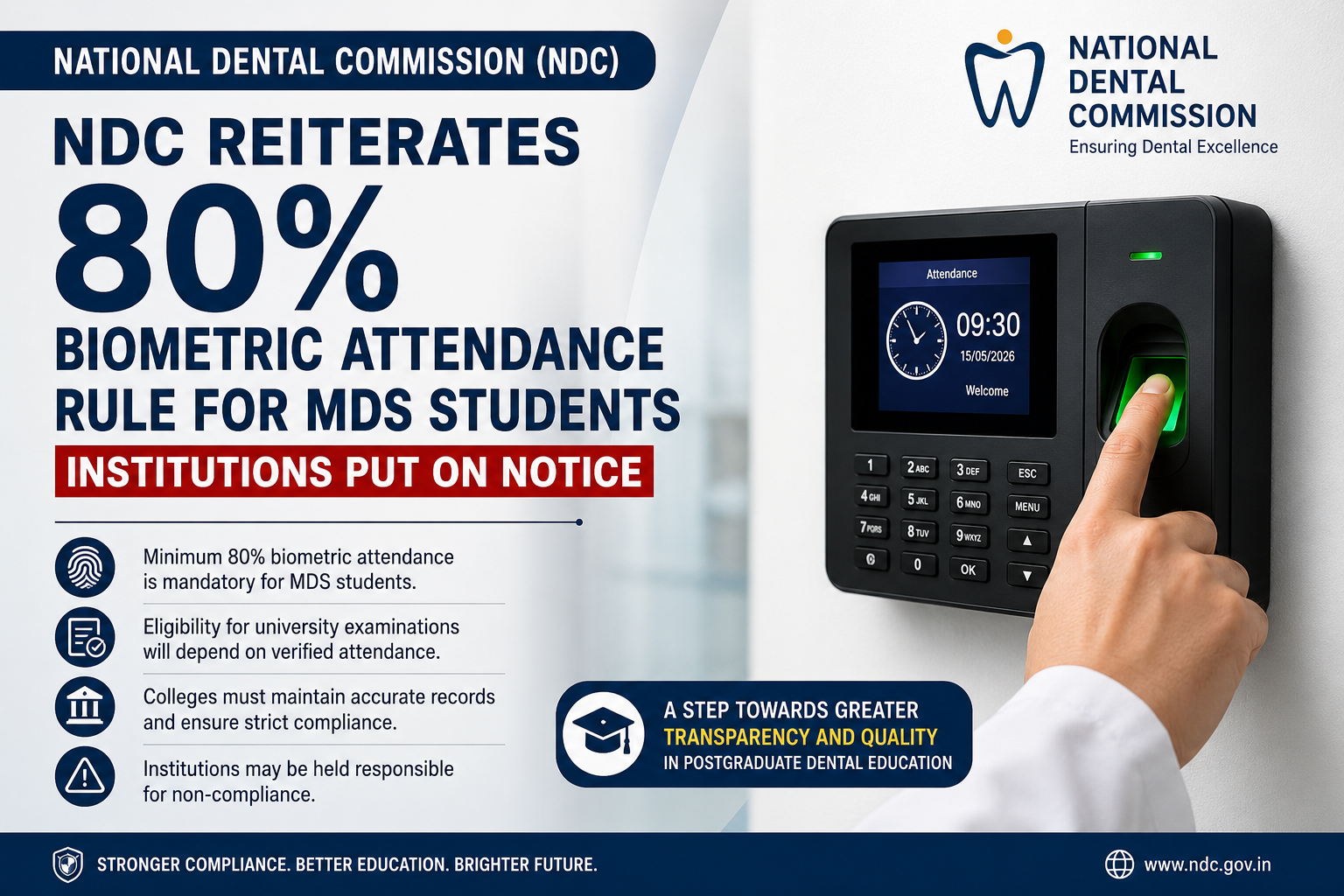
In a significant reaffirmation of academic accountability in postgraduate dental education, the National Dental Commission (NDC) has once again directed all universities and dental colleges across India to strictly enforce the mandatory 80% biometric attendance requirement for postgraduate (MDS) students before permitting them to appear for university examinations.
The latest circular is not a new regulation, but a formal reminder to institutions to implement the existing statutory provisions without exception. The Commission has reiterated that every postgraduate dental student must fulfil the prescribed biometric attendance requirement in accordance with Regulation 18(a)(i) of the erstwhile Dental Council of India (DCI) Master of Dental Surgery Course Regulations, 2017. Institutions that fail to comply with these directions may themselves be held accountable for regulatory violations. (The Indian Express)
Why Has the NDC Issued This Reminder?
The Commission’s renewed directive follows reports of non-compliance with attendance requirements in certain postgraduate dental programmes. The original circular, issued on 19 January 2026 by the erstwhile Dental Council of India (DCI), was prompted by complaints received from institutions in Rajasthan, Haryana and Uttar Pradesh regarding inadequate adherence to mandatory attendance norms.
The latest communication, issued on 24 June 2026, reiterates that the attendance provisions must now be implemented uniformly across all recognised dental institutions in the country to ensure consistency and regulatory compliance. (National Dental Commission)
Key Directions Issued by the Commission
Under the reiterated directive:
- A minimum of 80% biometric attendance is mandatory for every postgraduate (MDS) student.
- Eligibility to appear for university examinations will depend upon verified biometric attendance records.
- Universities and dental colleges must maintain accurate biometric attendance records before forwarding examination applications.
- Institutions permitting ineligible students to appear for examinations may themselves be held responsible for non-compliance with the regulations. (The Indian Express)
Strengthening Transparency in Postgraduate Dental Education
Biometric attendance systems serve a purpose beyond administrative record-keeping. They provide an objective mechanism to ensure that postgraduate students actively participate in clinical postings, seminars, journal clubs, laboratory training, research activities and patient care—all of which constitute essential components of specialist dental education.
By promoting regular academic engagement and clinical exposure, the policy seeks to strengthen competency-based training and enhance the quality of future dental specialists across the country.
DentistryUnited Perspective
The Master of Dental Surgery programme is designed not merely to prepare candidates for university examinations but to cultivate clinical expertise, scientific reasoning, research aptitude, teaching skills and ethical professional practice. Attendance requirements should therefore be viewed as an integral component of quality assurance rather than a procedural formality.
Although institutions may need to strengthen their biometric monitoring systems to ensure complete compliance, uniform implementation of these regulations is expected to improve the credibility, transparency and overall standards of postgraduate dental education in India.
DentistryUnited will continue to monitor regulatory developments issued by the National Dental Commission and provide timely, evidence-based updates relevant to the dental profession.
Official NDC Circular
Readers may access the official National Dental Commission circular here:
NDC News & Circulars – Biometric Attendance of Postgraduate (PG) Students
Direct PDF of the Circular:
Biometric Attendance of Postgraduate (PG) Students – Official Circular (PDF)