
In 2010, I was on a late-night international call with an NMD-trained dentist in the United States. I was not calling to argue philosophy. I was calling because something in the biomechanics of daily dentistry refused to sit quietly in my mind.
I had been thinking deeply about occlusion, implants, bridges, vertical dimension, force transmission, and temporomandibular disorders. The more I studied, the clearer it became that the disagreement in dentistry was not born of ignorance — it was born of differing foundational logic.
So I asked him two questions.
The first was biomechanical:
If an implant lacks a periodontal ligament — no viscoelastic damping, no periodontal mechanoreceptor feedback, no axial mobility — and is rigidly anchored through osseointegration, does it not experience repetitive stress concentration under functional and parafunctional loading? And could those unmodulated force vectors, transmitted directly to crestal bone and the surrounding stomatognathic architecture, alter condylar loading patterns and contribute to temporomandibular dysfunction over time?
The second followed naturally:
If a fixed partial denture preserves the PDL of the abutment teeth — maintaining proprioceptive afference and physiologic axial resilience — is it not, in carefully selected cases, more organically integrated into the neuromuscular feedback loop of the masticatory system? And if progressive attrition alters cusp inclines, flattens anterior guidance, and subtly diminishes vertical dimension of occlusion over years, should existing restorations — bridges, full-coverage crowns, and extensive composites alike — be periodically reassessed not merely for structural integrity, but for their continued role in preserving neuromuscular and skeletomuscular harmony?
There was silence.
Then he replied:
“Syed… I have a family. And you are an honest guy.”
It was not dismissal. It was recognition.
The questions were not purely technical — they had touched the economic architecture and philosophical scaffolding of contemporary restorative practice.
That call never left me.
If You Ask the Best in the World
If you ask one hundred of the finest clinicians in the world, “What is correct occlusion?” you will likely receive one hundred and one answers.
Each will be internally coherent. Each will be defensible within its own set of governing assumptions.
The divergence is not confusion.
It is contextual logic, interpreted through different diagnostic priorities.
Before we mount casts, set condylar guidance values, or chase contacts with articulating film, we must first calibrate the reasoning that will direct our instruments.
Occlusion is not tooth contact.
It is a biologic system in continuous adaptive motion.
The Governing Variable
Every occlusal philosophy, at its core, answers one question:
Who is the master of the system?
Is it the temporomandibular joint — demanding orthopedic stability of the condyle-disc-fossa complex?
Is it the neuromuscular envelope — prioritizing comfort, function, and absence of proprioceptive conflict?
Is it occlusal morphology — engineering force distribution through cusp-fossa relationships and anterior guidance?
Different schools chose different masters.
But they were not solving the same clinical equation.
The error begins when a single logic is universalized across all cases, all substrates, all adaptive states.
Conformative and Reorganized Thinking
When a patient presents with stable maximum intercuspation, adaptive neuromuscular equilibrium, and no signs of dysfunction, we preserve that equilibrium. We work within the existing occlusal scheme. That is conformative dentistry — and disrupting it in pursuit of geometric idealism can generate the very dysfunction we sought to prevent.
When we face a collapsed dentition, a lost vertical dimension, full-arch implant rehabilitation, or extensive wear beyond physiologic compensation, the existing reference is no longer reliable. We must reorganize. We establish a new therapeutic occlusion, often from a reproducible condylar reference position, and rebuild the system with biomechanical intention.
The decision between these two approaches is not ideological.
It is diagnostic.
The Implant Equation
The natural tooth is suspended within the periodontal ligament — a structurally complex, neurologically rich interface capable of detecting loads in the range of single-digit grams and modulating efferent jaw-closing muscle activity in milliseconds.
An implant has no such interface.
It is rigidly osseointegrated.
It lacks axial resilience.
It lacks periodontal mechanoreceptor input.
This is not a deficiency to be corrected — it is a biological reality to be respected in treatment design.
Force distribution must be consciously engineered.
Occlusal contact timing must be controlled, with implant-supported restorations typically relieved in maximum intercuspation and protected against lateral excursive loads.
Cantilever forces must be minimized.
Parafunctional habits must be identified and managed before loading.
Not because implants are inferior — but because the substrate has changed, and the occlusal logic must change with it. When the sensory interface is absent, the system cannot self-regulate in the same way. The clinician must compensate for what the biology no longer provides.
The Bridge Question
A conventional fixed partial denture retains the PDL of its abutment teeth. It preserves physiologic axial mobility, maintains periodontal mechanoreceptor continuity, and participates — to a degree — in the neuromuscular feedback loop of the masticatory system.
From a biomechanical standpoint, this may allow more organic load distribution within the periodontal apparatus under functional forces.
But restorations are static constructions placed within a dynamic biologic system.
Attrition modifies cusp inclines over time.
Anterior guidance flattens.
The vertical dimension of occlusion may subtly reduce.
Neuromuscular engrams adapt — sometimes imperceptibly, sometimes at clinical cost.
The question is not whether restorations should be replaced on a fixed schedule.
The question is whether we understand that occlusion is a living, adaptive system — one that demands ongoing clinical stewardship, not passive acceptance of the status quo.
The Overlooked Detail: The Finish Line
In an era of digital workflows, cone-beam volumetric imaging, guided implant surgery, and CAD/CAM-milled restorations, one element of classical tooth preparation remains biologically decisive and persistently underestimated:
The finish line.
We analyze taper meticulously.
We optimize emergence profiles digitally.
We verify path of insertion with precision software.
Yet it is the finish line — its location relative to the gingival margin, its continuity around the entire preparation circumference, its relationship to the biologic width — that largely governs:
The stress concentration profile within the remaining tooth structure.
The periodontal tissue response at the restoration margin.
The long-term functional health of the PDL.
The biological longevity of the abutment.
A poorly designed or incorrectly positioned margin can disrupt biologic width, promote crestal bone resorption, compromise the integrity of the junctional epithelium, and concentrate stress in zones ill-equipped to bear it — regardless of how precise the digital fabrication chain appears upstream.
Precision is not only digital.
It is biological. It begins at the hand of the clinician, at the margin, before the scanner is ever engaged.
How I Explain It to My Patients
In my practice, I tell patients something straightforward:
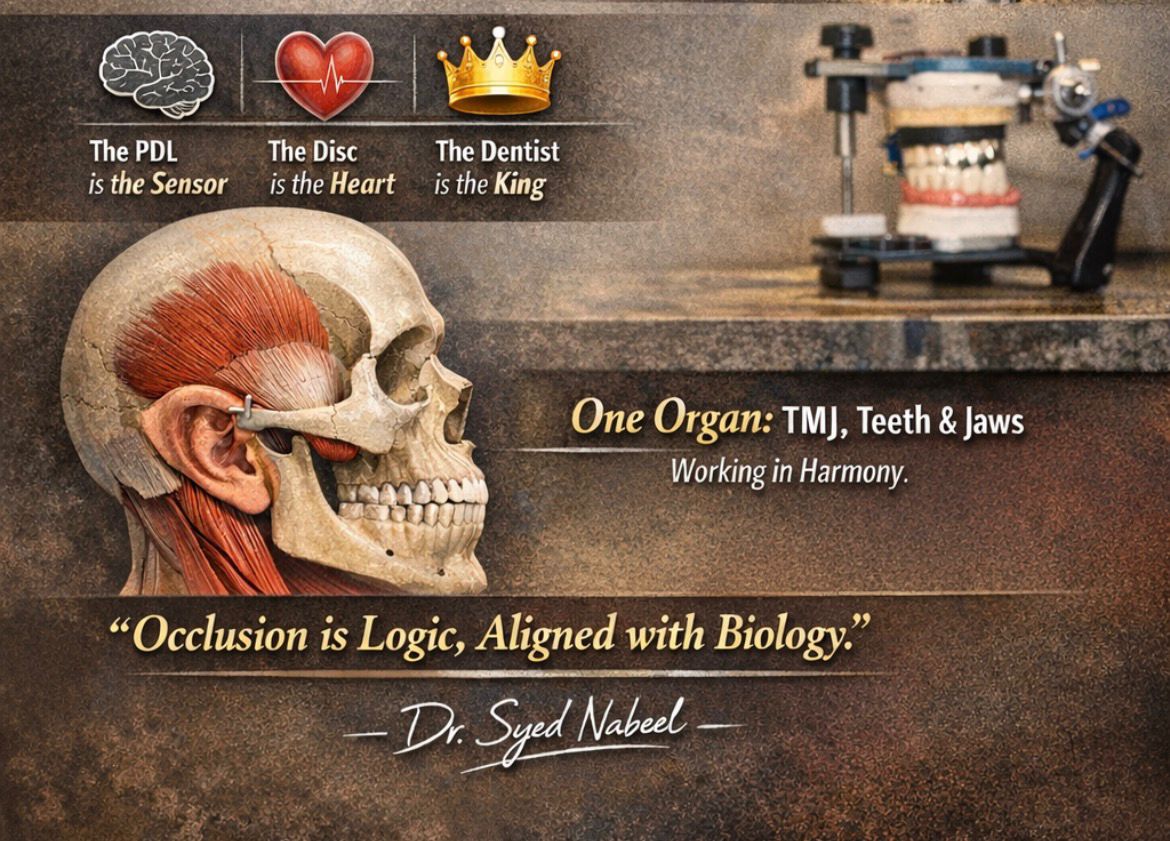
The temporomandibular joints, the maxillary teeth, the mandibular teeth, and the jaws together form one functional organ.
Like the heart — it is not a collection of independent parts.
It is an integrated system, and its coordinated function is essential for skeletal balance and neuromuscular efficiency.
When this system functions harmoniously, postural muscles relax, jaw movement becomes fluid and efficient, and the structures within bear load as they were designed to.
When it is destabilized — through occlusal discrepancies, lost vertical dimension, unplanned implant loading, or compromised joint mechanics — the consequences distribute through the musculoskeletal system in ways that are rarely confined to the mouth alone.
Occlusion is not about teeth.
It is about systemic harmony expressed through dental architecture.
A Simplified Framework
Over years of practice and reflection, I distilled the complexity into three guiding principles:
The king of the TMJ is the clinical judgment of the dentist.
The PDL is the sensory interface.
The articular disc is the structural heart of the joint.
If the sensory interface is disregarded, the structural heart absorbs unmodulated stress.
If the structural heart is destabilized, the entire masticatory system reorganizes around compensation.
Clinical reasoning must always precede instrumentation.
What That Call Ultimately Taught Me
That conversation in 2010 did not deliver a final answer.
It delivered intellectual responsibility.
Define your governing variable before you design.
Respect the biology of the substrate you are restoring.
Distinguish clearly between conformative and reorganized clinical intent.
Design margins with biological foresight, not only optical precision.
Modify your occlusal logic when the PDL is absent and the feedback loop has changed.
Occlusion is not mystical.
It is biomechanical reasoning, applied consistently, calibrated to context, and grounded in biology.
When logic aligns with biology, confusion recedes.
And when consistency governs treatment, predictability becomes not an accident —
but an outcome.
—
Dr. Syed Nabeel BDS, D.Orth, MFD RCS (Ireland), MFDS RCPS (Glasgow) MFDS RCS(Edin) , is a clinician-scholar whose career spans over two decades at the intersection of orthodontics, neuromuscular dentistry, and digitally integrated diagnostics. As Clinical Director of Smile Maker Clinics Pvt. Ltd., he has pioneered a philosophy of care rooted in anatomical precision, occlusal neurophysiology, and contemporary AI-enhanced workflows. A Diplomate in Orthodontics from Italy and an alumnus of advanced programs at Various International Universiteis , Dr. Nabeel brings a globally benchmarked clinical acumen to the nuanced management of temporomandibular disorders, esthetic rehabilitation, and algorithm-guided orthodontics.
In 2004, he founded DentistryUnited.com, a visionary platform connecting over 40,000 dental professionals through peer learning and collaborative dialogue. His academic drive led to the launch of Dental Follicle – The E-Journal of Dentistry (ISSN 2230-9489), a peer-reviewed initiative now indexed in EBSCO, fostering interdisciplinary scholarship across clinical domains.
A prolific educator, he has contributed to UGC and national broadcast media as a subject expert and regularly speaks at scientific forums, favoring small-group, discussion-based formats that emphasize clinical realism over theoretical abstraction. His ethos remains steadfast: knowledge, when shared freely, multiplies in value. Dr. Nabeel continues to shape the future of dentistry through research, mentorship, and his enduring commitment to elevating practice standards in India and beyond.