
By Dr. Syed Nabeel
Founder, DentistryUnited | Dental Clinician & Educator | Expert in Dental Curriculum Reform
Published: March 2026 | DentistryUnited.com
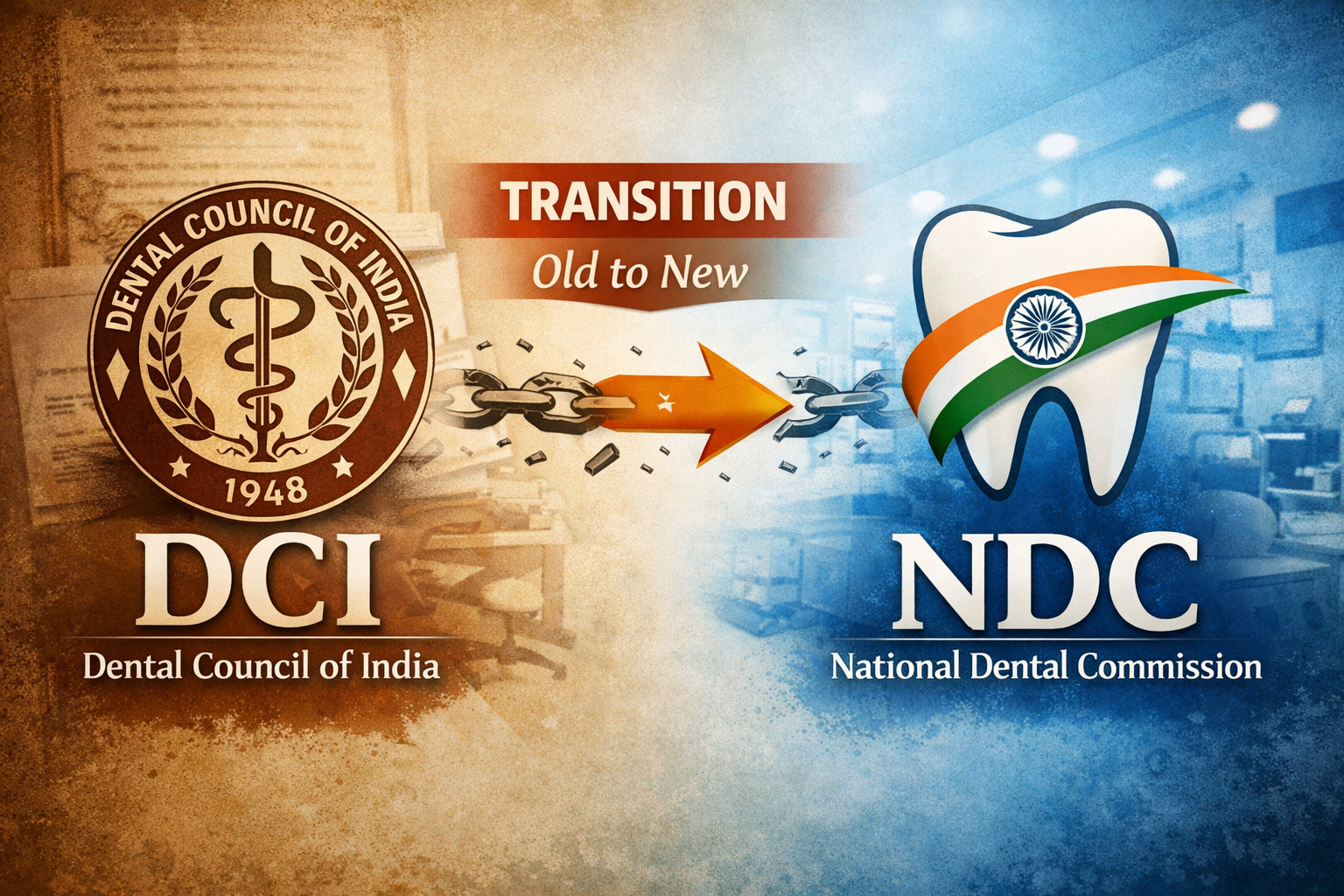
In a decisive policy shift effective March 19, 2026, the Government of India has replaced the Dental Council of India (DCI) with the National Dental Commission (NDC), formally repealing the Dentists Act of 1948. Dr. Sanjay Tewari has been appointed as the Commission’s first Chairperson.
The reform introduces a multi-board regulatory architecture, comprising three dedicated autonomous boards: the Undergraduate and Postgraduate Dental Education Board, the Dental Assessment and Rating Board (DARB), and the Ethics and Dental Registration Board. The intent is clear — to transition from a compliance-driven inspection model to a competency-based, outcomes-oriented regulatory ecosystem.
From Inspection to Accreditation Science
The earlier DCI framework relied heavily on periodic inspections, infrastructure checklists, and faculty counts. In contrast, the NDC signals a decisive move toward:
- Continuous accreditation cycles rather than episodic inspections
- Outcome-based dental education (OBE) with measurable clinical competencies
- Standardised licensure pathways and ethical governance frameworks
- Fee regulation for 50% of seats in private dental colleges and deemed universities, linked to institutional grading and transparency metrics
This aligns Indian dentistry with global regulatory philosophies seen in advanced systems where clinical output, patient safety indices, and evidence-based treatment planning define institutional credibility.
Why This Reform Matters Now
India produces one of the largest cohorts of dental graduates globally, yet concerns persist regarding clinical preparedness, interdisciplinary integration, and real-world applicability of training.
This concern is not new.
As I have articulated over the years through DentistryUnited — a platform built on open knowledge exchange, global benchmarking, and systems-based thinking in dentistry — Indian dental training has long suffered from a structural deficit. In my widely discussed blog, “The Fragmentation in Indian Dental Education: A Call for Integration,” I observed that Indian dental training often remains fragmented, where foundational sciences are taught without clinical context, leading to graduates who know the what, but not the why — and certainly not the how.
I also highlighted the absence of horizontal and vertical curriculum integration, resulting in a persistent disconnect between basic sciences, clinical reasoning, and chairside execution. In another reflective piece, I warned that institutions risk producing clinicians who follow a checklist but struggle to diagnose and heal — pointing to the erosion of clinical judgment and patient-centric care.
Viewpoint: A System Finally Listening
For years, many of us in academia and clinical practice have articulated the need for a fundamental reboot of Indian dental education — not cosmetic changes, but structural reform. With the transition from the Dental Council of India to the National Dental Commission, it appears that the system has, at last, begun to listen.
This reform has the potential to be a true game changer, particularly if it addresses three chronic deficits:
1. From Fragmentation to Integration
Indian dental education has long suffered from disciplinary silos — anatomy without occlusion, microbiology without periodontology, prosthodontics without systemic medicine.
What we need — and what the NDC could enable — is a spiral, integrated curriculum where:
- Basic sciences inform diagnosis
- Clinical subjects are taught through case-based, evidence-driven modules
- Students are trained in treatment sequencing, risk assessment, and long-term maintenance protocols
Without this, we will continue to produce degree holders, not decision-makers.
2. From Quantity to Clinical Competence
The future of dentistry cannot be built on numerical output of graduates alone. We need:
- Competency-based clinical logbooks — not just procedural counts
- Exposure to complex cases: TMD, full-mouth rehabilitation, implant-prosthetic integration
- Training in digital workflows: intraoral scanning, CAD-CAM prosthodontics, AI-assisted diagnostics
If the DARB evolves into a true Dental Outcomes Authority — measuring not infrastructure but clinical reasoning and treatment success — the shift will be profound.
3. From Regulation to Intelligent Governance
Regulation must evolve into data-driven governance. The NDC must eventually incorporate:
- AI-powered audit systems tracking treatment outcomes and complication rates
- National registries for implants, prosthetics, and adverse events
- Real-time accreditation dashboards rather than static inspection reports
This is where India can leapfrog — by integrating digital dentistry with digital regulation.
A Moment of Alignment
What makes this reform particularly significant is its timing. For over two decades, through DentistryUnited, the emphasis has been on open knowledge exchange, global benchmarking, and systems-based thinking in dentistry.
The current policy shift reflects many of these principles:
- Integration over isolation
- Competency over compliance
- Transparency over opacity
For the first time, there is a visible alignment between grassroots clinical concerns and national regulatory direction.
Cautious Optimism: Execution Will Define Success
However, a note of caution is essential. India has historically produced strong policy frameworks that falter at the level of implementation, monitoring, and accountability.
For the NDC to succeed, it must ensure:
- Autonomy from political and institutional bias
- Inclusion of active clinicians — not just administrators — in decision-making
- Continuous feedback loops from students, practitioners, and patients
The Final Word
The replacement of the Dental Council of India with the National Dental Commission is more than a regulatory update — it is a philosophical reset.
This could mark the moment when Indian dentistry transitions:
- From fragmented knowledge to integrated thinking
- From procedural dentistry to predictive, patient-centred care
- From regulation to true governance
If executed with clarity and conviction, this reform will not just change how dentistry is regulated in India — it will redefine how it is taught, practiced, and experienced.

Dr. Syed Nabeel BDS, D.Orth, MFD RCS (Ireland), MFDS RCPS (Glasgow) MFDS RCS(Edin) , is a clinician-scholar whose career spans over two decades at the intersection of orthodontics, neuromuscular dentistry, and digitally integrated diagnostics. As Clinical Director of Smile Maker Clinics Pvt. Ltd., he has pioneered a philosophy of care rooted in anatomical precision, occlusal neurophysiology, and contemporary AI-enhanced workflows. A Diplomate in Orthodontics from Italy and an alumnus of advanced programs at Various International Universiteis , Dr. Nabeel brings a globally benchmarked clinical acumen to the nuanced management of temporomandibular disorders, esthetic rehabilitation, and algorithm-guided orthodontics.
In 2004, he founded DentistryUnited.com, a visionary platform connecting over 40,000 dental professionals through peer learning and collaborative dialogue. His academic drive led to the launch of Dental Follicle – The E-Journal of Dentistry (ISSN 2230-9489), a peer-reviewed initiative now indexed in EBSCO, fostering interdisciplinary scholarship across clinical domains.
A prolific educator, he has contributed to UGC and national broadcast media as a subject expert and regularly speaks at scientific forums, favoring small-group, discussion-based formats that emphasize clinical realism over theoretical abstraction. His ethos remains steadfast: knowledge, when shared freely, multiplies in value. Dr. Nabeel continues to shape the future of dentistry through research, mentorship, and his enduring commitment to elevating practice standards in India and beyond.