
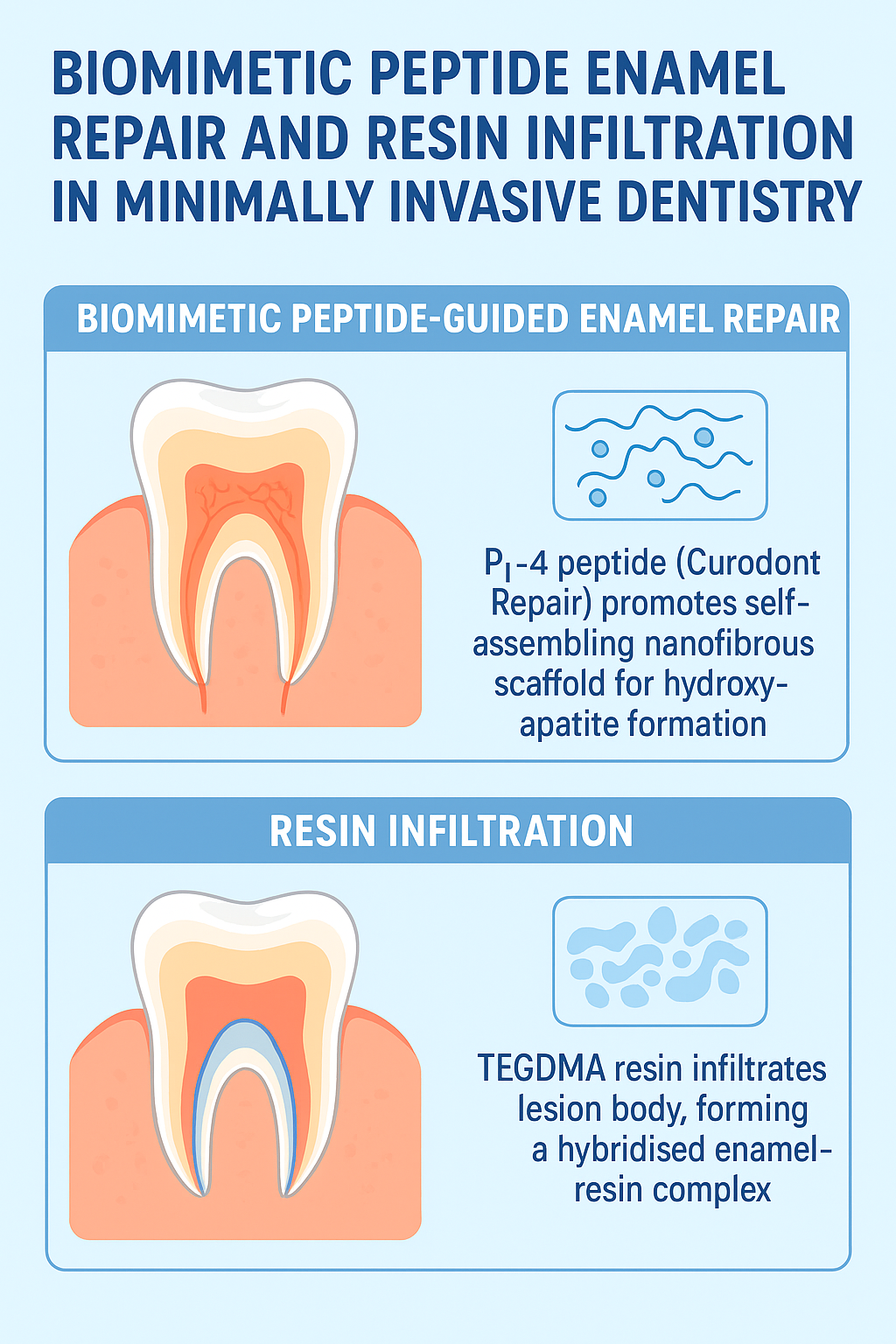
"Biomimetic peptide enamel repair"
Dr. Hajeera's Space

Guided Enamel Remineralisation and Resin Infiltration: Moving from Restoration to Regeneration in Early Caries

09/12/2025
For much of the past century, operative dentistry has been anchored in a “drill-and-fill” paradigm that viewed enamel and outer-dentin lesions as mechanically defective rather than biologically dynamic. This philosophy is now being challenged. Contemporary minimally invasive dentistry has introduced two clinically validated, micro-invasive interventions capable not only of arresting but, in selected cases, partially reversing early carious lesions: biomimetic peptide–guided enamel remineralisation and resin infiltration.
 
Biomimetic Peptide–Guided Enamel Repair
 
The self-assembling peptide P₁₁-4 (commercially available as Curodont Repair) represents a notable advance in biomimicry. After gentle preconditioning with 2–3% sodium hypochlorite and 15–20% phosphoric acid to disrupt the pseudo-intact surface layer, the peptide monomers self-assemble into a nanofibrous scaffold under physiological conditions. This matrix functions analogously to amelogenin, guiding the nucleation and conversion of amorphous calcium phosphate into organised hydroxyapatite crystallites aligned with native enamel prisms.
 
Randomised controlled trials and split-mouth studies report meaningful improvements in fluorescence metrics (ΔF) and measurable reductions in lesion depth on digital subtraction radiography when applied to non-cavitated E1/E2 and shallow D1 lesions (ICDAS 1–3). Regression rates approaching 70–80% at 6–12 months have been described in high-risk populations when the technique is supported by stringent plaque control and adjunctive remineralisation strategies. Predictability is highest in lesions located within the outer 200–300 µm of enamel, where diffusion channels remain sufficiently open to support mineral transport.
 
Resin Infiltration (ICON Technique)
 
Resin infiltration, using low-viscosity TEGDMA resin, targets the lesion body rather than the surface alone. Following 120 seconds of 15% hydrochloric acid micro-abrasion to remove the hypermineralised surface zone, capillary action allows the infiltrant to penetrate 600–800 µm into the demineralised enamel. The polymerised resin forms a hybridised enamel–resin complex that occludes diffusion pathways, reducing mineral loss (ΔZ) by up to 90% and effectively halting lesion progression.
 
Aesthetic enhancement is a secondary benefit: by replacing water in the lesion pores and matching the refractive index of enamel, the technique can significantly improve the appearance of post-orthodontic or fluorotic white-spot lesions. Long-term observational data extending 7–10 years demonstrate high retention (>95%) and excellent progression-free survival (>90%) for proximal E2 lesions when moisture control is uncompromised.
 
Clinical Decision Pathway
 
A rational, stage-specific protocol can guide everyday practice:
  • ICDAS 1 (early enamel change when air-dried): Peptide-guided regeneration is preferred.
  • ICDAS 2 (visible enamel change when wet) with aesthetic concerns: Resin infiltration, alone or combined with peptide therapy.
Proximal E2 or shallow D1 lesions: Resin infiltration is usually first-line; peptides may be considered in high-risk individuals.
 
Any lesion with cavitation or undermined enamel >300–400 µm: Non-restorative strategies are no longer appropriate; minimally invasive operative care is indicated.
 
Essential Considerations
 
Neither strategy can reconstruct enamel once macro-cavitation or structural collapse has occurred. Both demand rigorous isolation, thorough removal of surface biofilm, and sustained preventive measures. Without meaningful modification of diet, plaque control, and salivary function, lesion reactivation may occur even under an apparently sealed surface.
 
Conclusion
 
The complementary roles of peptide-mediated enamel repair and resin infiltration have reshaped the management of early carious lesions. These modalities replace passive “monitoring” with biologically driven intervention that preserves enamel architecture, interrupts the cycle of repeated restorations, and fundamentally redefines the goals of operative dentistry. Increasingly, the central question is no longer how little tooth structure should be removed, but how much natural tissue can be conserved and regenerated.

About the Author

Dr. Hajeera Banu is a skilled dentist who graduated from RGUHS in 2014 and has since built a successful career in the field. With a strong focus on implants, restorative dentistry, and aligners, she has honed her expertise to offer her patients the highest level of care. Based in Mysore, India, Dr. Banu runs her own private practice, where she combines advanced dental techniques with a patient-centered approach.

Her passion for dentistry extends beyond her practice; she stays up-to-date with the latest advancements in the field to ensure she delivers the best outcomes. Outside of her professional life, Dr. Banu enjoys blogging, where she shares insights and experiences from her dental journey, as well as her love for cooking and traveling. These interests help to balance her dynamic lifestyle, and she continues to seek personal and professional growth in all aspects of her life. email dentistryunited@gmail.com