
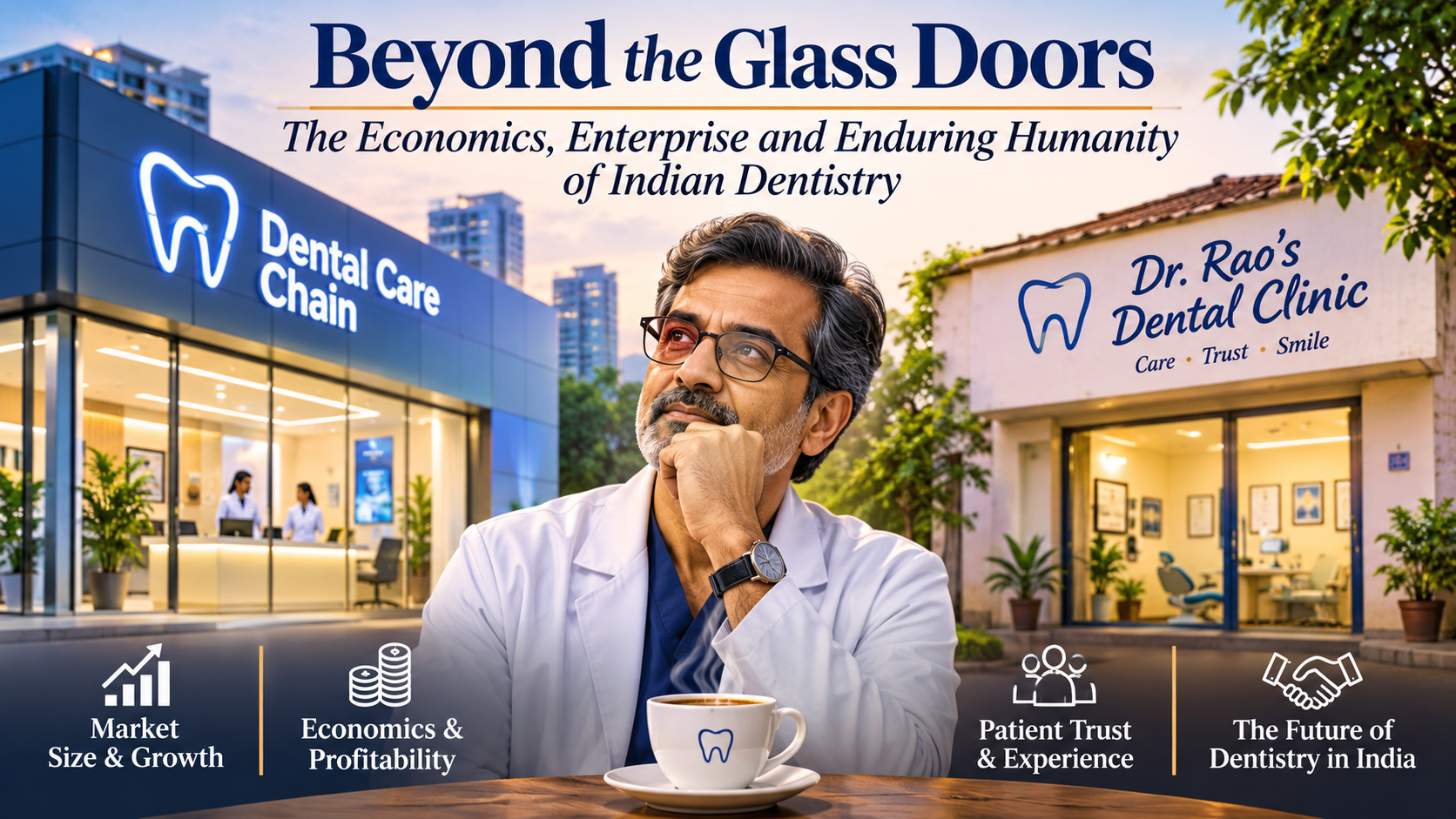
Of corporate ambitions, independent practitioners, and the numbers that tell a story far more nuanced than market share.
Prologue: Two Clinics on the Same Evening
It was past eight in the evening in Mysore. The evening rain had just settled, leaving the air cool and carrying the faint aroma of freshly brewed filter coffee from the corner darshini.
Inside my clinic, the sterilizer hummed softly as I wrapped up the notes from my final consultation of the day.
Across the road, the bright LED signage of a newly opened corporate dental chain glowed through its sleek glass façade. Two young doctors in crisp, matching coats were closing out their digital dashboards for the night.
A young colleague who had dropped by for tea looked across the street and asked me a question I hear almost every week from graduating dentists and worried clinic owners alike:
“Sir, looking at those lights and those marketing budgets, does the standalone Indian dental clinic still have a future?”
To answer that question honestly, we must step away from apprehension and examine the numbers. Because in dentistry, just as in clinical diagnosis, clarity begins when we look beyond appearances and investigate the evidence.
1. The Canvas: How Big Is India’s Dental Landscape?
Before comparing who is winning, let us appreciate the sheer scale of the landscape we are discussing.
- A $4.3 Billion Market: India’s dental services sector was valued at roughly $4.3 billion (over ₹36,000 crore) in 2025. Driven by growing awareness of preventive care, cosmetic dentistry, implants and clear aligners, it is projected to grow at more than 12% annually, potentially crossing $8.5 billion by 2031.
- Over 381,000 Registered Dentists: Supported by more than 325 dental colleges, India produces tens of thousands of new clinicians every year. Roughly 12,000 to 15,000 new clinics are estimated to open annually across metros, towns and Tier-3 cities.
- The Unorganised Majority: Despite the glossy advertisements on highways and social media, an estimated 95% to 98% of India’s dental market remains in the hands of standalone, independent practices.
- A Small Corporate Footprint: Organised corporate chains collectively account for a relatively small share of the overall market, despite their considerable visibility in urban centres. Even India’s largest corporate chain, Clove Dental, with its extensive network, alongside players such as Apollo Dental, Sabka Dentist and Partha Dental, represents only a fraction of the country’s enormous dental landscape.
When you step back and examine these figures, the first misconception begins to dissolve: corporate dentistry has not swallowed the independent practitioner. It has organised a visible, commercially significant segment of a much larger and geographically diverse market.
The distinction between visibility and dominance is worth remembering.
2. Behind the Reception Desk: The Economics of Two Worlds
Why haven’t corporate chains replaced the neighbourhood dentist in the way supermarket chains transformed small grocery stores?
The answer lies somewhere between the balance sheet and the dental chair — specifically, in the economics of running a practice.
| The Real-World Numbers | Standalone Clinic (1–2 Chairs) | Corporate Chain Clinic (2–3 Chairs) |
|---|---|---|
| Initial Setup Cost (Capex) | ₹8 lakh–₹20 lakh | ₹35 lakh–₹60 lakh+ |
| Space and Location | 400–700 sq. ft.; residential or community locations | 800–1,200 sq. ft.; high-visibility commercial locations |
| Monthly Fixed Overheads | ₹80,000–₹2 lakh | ₹2.5 lakh–₹8 lakh |
| Time to Break Even | 6–12 months | 12–30 months |
| Doctor Remuneration | Owner retains profits; visiting specialists often work on revenue share | Fixed salary with performance or quality-linked incentives |
| Patient Fee Structure | Often more flexible, with lower overheads | Generally structured, standardised urban fee schedules |
These figures are indicative estimates and vary considerably with city, location, clinic size, utilisation, staffing and business model. Break-even periods should not be treated as guaranteed industry averages.
Look closely at the break-even equation.
A dentist who establishes a thoughtfully designed, hygienic two-chair practice with disciplined capital allocation has the advantage of relatively modest fixed costs. There is no corporate headquarters to support, no layers of regional management, and no external investor waiting for the next valuation milestone.
A corporate clinic, by contrast, must account for premium rentals, central marketing, administrative infrastructure, technology platforms, compliance systems and management overheads before the first patient settles into the chair.
Scale brings purchasing power and brand visibility. But it also brings an entirely different cost structure.
The independent dentist’s greatest financial advantage is often not higher revenue. It is the ability to operate sustainably with fewer moving parts.
3. The Human Equation: Where Each Model Wins and Struggles
Dentistry, however, is never practised on a spreadsheet.
It is practised in that quiet space between two human beings — one holding a mirror and handpiece, the other placing an extraordinary amount of trust in their hands.
There are certain realities that make the Indian dental market particularly interesting.
The Out-of-Pocket Reality
Unlike many hospital-based procedures, routine dental care in India remains largely an out-of-pocket expense. Patients and families frequently pay directly from their savings.
When patients pay with their own money, value, affordability and trust become central to the decision.
An independent practice, with its relatively lower overheads, often has greater flexibility in pricing. It can offer accessible treatment without necessarily compromising on materials, clinical standards or professional judgement.
The Specialist Advantage
Where well-organised corporate chains can excel is in operational scale and access to specialists.
A network of clinics can deploy endodontists, implantologists, orthodontists and periodontists across multiple locations. Instead of requiring every clinic to employ a full-time specialist, the organisation can create a shared specialist ecosystem.
Bulk procurement, centralised laboratory arrangements, standardised protocols and technology investments can also generate meaningful efficiencies.
These are genuine advantages of scale. The question is whether those efficiencies consistently translate into better clinical outcomes and patient experiences.
The Revolving Door Versus Doctor Continuity
One of the persistent vulnerabilities of a multi-location corporate model is doctor attrition.
Young associates may join a chain to gain experience, develop clinical confidence and understand the business of dentistry. A few years later, many aspire to establish independent practices of their own.
There is nothing inherently wrong with this. It is a natural progression in a profession where entrepreneurship has always been part of the journey.
But consider the patient’s perspective.
Someone undergoing a complex root canal, implant rehabilitation or orthodontic treatment is not merely purchasing a clinical procedure. They are entering into a relationship that may extend over several months or even years.
A change of clinician midway through treatment can affect confidence and continuity.
An independent practice often enjoys a natural advantage here: the same dentist who diagnoses the problem is frequently the one who performs the treatment, monitors the healing and remains accountable long after the procedure is completed.
Technology can standardise processes. A familiar doctor can build trust.
Both matter, but they are not interchangeable.
4. What the Independent Dentist Must Do Next
If you run an independent practice today, the lesson from these numbers is neither complacency nor panic.
It is evolution.
Patients do not necessarily reject a clinic because it is small. They leave when the experience feels outdated, disorganised, inconsistent or opaque.
The independent dentist does not need to imitate a corporate chain. The challenge is to adopt its best systems while preserving the personal relationships that make independent practice distinctive.
Five habits can make a meaningful difference.
1. Make Hygiene Visible
Corporate chains often understand the importance of communicating hygiene and sterilisation standards.
Independent clinics can do the same.
Open sealed autoclave pouches in front of patients. Maintain proper sterilisation records. Use digital radiography and intraoral cameras to make diagnosis more transparent.
Patients should not merely be assured that a clinic is hygienic. They should be able to see the systems that make it so.
2. Build a Visiting Specialist Network
You do not need to own five clinics to offer multidisciplinary dentistry.
Develop relationships with trusted local MDS colleagues — endodontists, oral surgeons, periodontists, prosthodontists and orthodontists.
Invite them on designated days through transparent professional arrangements.
A well-connected independent clinic can provide an impressive range of services without carrying the fixed costs of a large permanent team.
3. Move From Pain Relief to Preventive Care
Do not wait for a toothache to bring a patient back.
Introduce structured recall systems, six-monthly cleaning reminders and periodic oral health reviews.
A simple WhatsApp reminder, delivered at the right time, can make a difference to both patient health and practice continuity.
The transition from episodic treatment to preventive care is not merely a business strategy. It is a more responsible way of practising dentistry.
4. Offer Transparent Pricing and Flexible Payment Options
Fear of unexpected expenses prevents many patients from accepting treatment, particularly for implants, full-mouth rehabilitation and clear aligners.
Explain treatment alternatives, disclose costs upfront and offer appropriate payment flexibility.
Where healthcare EMI arrangements are available, they can help patients distribute larger expenses into manageable instalments.
Financial transparency is not a sales technique. It is an extension of informed consent.
5. Protect the Soul of Care
Perhaps this is the most important point.
Never allow the pursuit of daily targets to replace the purpose of a consultation.
Sit eye-to-eye with your patient. Listen before diagnosing. Explain why a treatment is necessary before discussing what it costs.
A patient may forget the brand of the implant, the model of the scanner or the name of the restorative material.
But they rarely forget how a dentist made them feel when they were anxious, vulnerable or in pain.
That is an advantage no marketing budget can easily manufacture.
The Final Word
As my young colleague finished his tea and stepped out into the cool Mysore night, I found myself reflecting on the two clinics across the road from each other.
One had the unmistakable advantages of scale — a recognisable brand, sophisticated systems, marketing muscle and the promise of standardisation.
The other had something less visible but equally valuable: familiarity, personal accountability and years of relationships built one patient at a time.
Both have a place in the future of Indian dentistry.
Corporate chains will undoubtedly continue to expand, particularly in urban markets. They can bring welcome investments in technology, structured processes, specialist access and organised dental awareness. Their contribution to the profession should not be dismissed.
Equally, independent dentistry should not mistake its present market dominance for a guarantee of future success. It must modernise, professionalise and become more accountable.
The future may not belong exclusively to either model. It may belong to those who understand what each does best.
Because technology can scan an arch in thirty seconds. Marketing can bring a patient through the front door. A well-designed clinic can create a wonderful first impression.
But the enduring relationship between a dentist and a patient is built over time — through competence, integrity, empathy and continuity.
And perhaps that is the one thing we must never lose sight of.
The future of dentistry may be corporate, independent or somewhere in between. But the soul of dentistry must always remain human.
A Note on the Author
Dr. Syed Nabeel’s essays on DentistryUnited have developed a distinctive voice of their own. Often beginning with an ordinary moment — a quiet evening at the clinic, a cup of filter coffee, an unexpected conversation with a colleague — his narratives gradually open into larger reflections on dentistry, professional life, human relationships and the business of healthcare.
His writing brings together clinical experience, thoughtful observation and a healthy curiosity about the changing world around us. He has a particular fondness for looking beyond the obvious, questioning accepted wisdom and finding the human story behind clinical and commercial realities.
He also makes no secret of his willingness to embrace emerging tools, including Artificial Intelligence, as part of the creative and intellectual process. For him, AI is neither a substitute for professional experience nor a replacement for independent thought. It is an additional instrument — much like a digital scanner or a diagnostic aid — that can help organise ideas, explore perspectives and give expression to thoughts that might otherwise remain unwritten.
The observations, questions and professional reflections remain rooted in the author’s perspective; technology simply helps shape the conversation.
This essay continues in that spirit — part observation, part analysis and part reflection on a profession standing at an interesting crossroads.