
Dyson CameraJet: When Your Toothbrush Becomes a Camera, AI System and Flosser
Dyson’s £419.99 CameraJet brings AI, live intraoral imaging and targeted liquid flossing into a toothbrush — but the real innovation may be behavioural rather than mechanical.
DentistryUnited News Analysis | 2 September 2026
The toothbrush has been largely unchanged in principle for generations: put bristles against teeth, apply the correct technique, repeat twice a day.
Dyson has now decided that the problem is not simply how powerful the toothbrush is, but whether the user can see what they are actually missing.
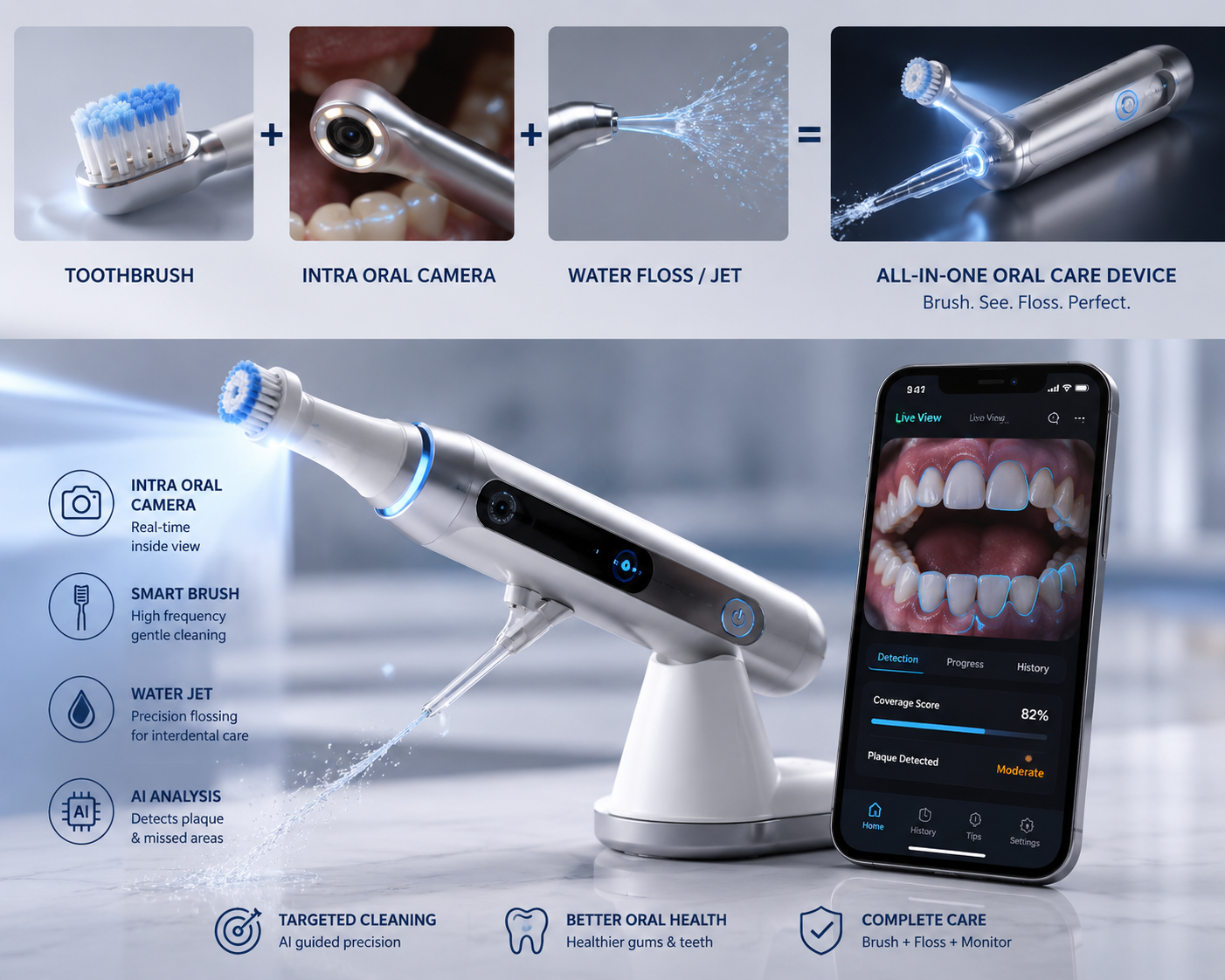
On 1 September in Paris, Dyson launched the CameraJet, its first electric toothbrush and the centrepiece of a broader Dyson Dental System. Priced at £419.99 in the UK, the device combines a 100,000-pixel macro camera, machine learning, variable sonic brushing and a precision mouth-rinse jet.
The unusual proposition: watch yourself brush
The CameraJet places a miniature 1 mm intraoral camera close to the brush head. It captures 28 images per second and feeds them into Dyson’s machine-learning system, branded Gap Optical Targeting™.
When the system detects an interdental gap, it can trigger a targeted burst of mouth rinse through a conical jet. Dyson says the response occurs within approximately 100 milliseconds. The device’s machine-learning system was developed using more than 470,000 dental images, while the overall product involved 661 Dyson engineers and six years of development.
The camera also streams a live view to the MyDyson app, effectively allowing the user to watch their own teeth while brushing.
That is arguably the most interesting aspect of CameraJet.
For the first time, the toothbrush is not merely a cleaning instrument; it is also a visual feedback system.
Dyson is trying to solve a very familiar dental problem
From a dental perspective, the company’s underlying premise is hardly revolutionary.
Patients routinely miss posterior teeth, lingual surfaces, cervical margins and—most importantly—interdental areas. A sophisticated toothbrush cannot compensate completely for poor adherence, inadequate duration or poor technique.
Dyson’s approach is therefore to make the invisible visible.
The app provides guided cleaning, coverage mapping and feedback about areas that have been missed. Dyson says the camera images are processed in real time and are not stored on the device or in the cloud.
This creates an interesting behavioural proposition:
Instead of telling patients that they are missing areas, show them.
For patient motivation, that could potentially be more powerful than another vibration motor or another brushing timer.
But is “liquid flossing” actually flossing?
This is where dental professionals should look beyond the marketing terminology.
The CameraJet uses a targeted conical mouth-rinse jet, rather than conventional string floss. Dyson calls this “precision-flossing”, and the device can automatically direct the jet into detected interdental spaces.
That is an impressive engineering solution to interdental cleaning—but it should not automatically be interpreted as meaning that a camera-guided liquid jet is clinically interchangeable with every form of interdental cleaning.
Interdental anatomy varies enormously. Tight contacts, open embrasures, root concavities, periodontal pockets, orthodontic appliances, implants and restorations present different cleaning requirements.
The clinically relevant question is therefore not whether the jet can reach a gap. It is whether long-term use produces meaningful improvements in plaque control, gingival inflammation and periodontal outcomes across different patient populations.
That evidence will take considerably longer to establish than the product launch.
The evidence deserves a closer look
Dyson reports impressive numbers—including claims of up to 72% more plaque removal than market-leading premium electric toothbrushes in laboratory testing of difficult-to-reach areas. However, that figure comes from a specific laboratory comparison rather than a long-term clinical outcome study.
Dyson also reports a clinical test involving 71 participants over four weeks, twice daily, comparing the Dyson system with a manual toothbrush using Dyson formulations.
Those findings are encouraging, but they should be interpreted in context.
A 71-person, four-week study is very different from a large, independently replicated, long-duration clinical trial comparing CameraJet with established electric toothbrushes and established interdental-cleaning methods.
There is also an important distinction between:
plaque removal → gingival improvement → prevention of periodontal disease/caries → long-term oral-health outcomes.
These are related, but they are not interchangeable endpoints.
The engineering, however, is genuinely interesting
Even dentists who remain sceptical about the price should acknowledge that Dyson has approached oral care as an engineering problem rather than simply putting its logo on another sonic toothbrush.
The company has developed its own proxy plaque in collaboration with the National University of Singapore Faculty of Dentistry, allowing engineers to test different jet geometries repeatedly during development. It chose a broad conical jet rather than a conventional narrow “needle” profile and designed an anti-gravity reservoir so the 12.5 ml mouth-rinse tank can deliver fluid even when the toothbrush is held horizontally.
The brush also incorporates variable sonic oscillation intended to prevent bristle stalling, dual-bristle architecture, RFID-enabled brush heads and a refill/charging dock.
In other words, the camera is only one component of a much larger engineering system.
And then there is the toothpaste
Dyson has not stopped at the toothbrush.
The company is launching a broader dental system containing its own non-foaming toothpaste and low-foaming mouth rinse, specifically formulated so that foam does not interfere with the camera’s field of view and interdental detection.
This is strategically important.
Dyson is not simply selling a £420 toothbrush. It is attempting to establish an oral-care ecosystem—device, brush heads, formulations, software and consumables.
That business model is familiar from other technology categories, but relatively new territory for premium oral care.
The elephant in the bathroom: £419.99
At £419.99, CameraJet is unquestionably a premium product.
The question for dentistry is whether the additional technology translates into enough additional adherence and clinical benefit to justify the cost.
For a patient who already brushes twice daily for two minutes, cleans interdentally appropriately and maintains regular professional care, the marginal benefit may be difficult to justify.
For another patient—the chronic non-flosser who repeatedly misses the same areas despite years of instruction—the equation could be very different.
The greatest value of CameraJet may ultimately lie not in making a good brusher better, but in making a poor brusher more aware.
What dentists should watch next
The most interesting developments will not be the launch videos. They will be the independent evidence that follows.
Dentists should be looking for:
* independent clinical trials rather than manufacturer testing alone;
* comparisons with leading sonic and oscillating-rotating toothbrushes;
* comparisons with established interdental devices;
* long-term gingival and periodontal outcomes;
* evidence in orthodontic, implant and periodontal patients;
* usability and adherence over six to twelve months;
* whether visual feedback genuinely changes behaviour;
* and whether patients become better cleaners—or simply become fascinated by watching their mouths.
There is also a fascinating privacy question. Dyson states that the camera images are not stored or shared and that the live images are deleted after viewing.
That will matter increasingly as AI, cameras and connected health devices move from the clinic into the bathroom.
The bigger story
Dyson’s entry into dentistry should not be dismissed as simply another expensive electric toothbrush.
Nor should the company’s marketing claims be accepted uncritically.
The significant development is the convergence of intraoral imaging + artificial intelligence + fluid dynamics + behavioural feedback + consumer oral care in a single device.
The toothbrush is becoming a sensor.
And that may be the beginning of a much bigger transformation.
For decades, dentistry has relied on telling patients what they are doing wrong. CameraJet represents a different philosophy:
Show them. Measure it. Give them feedback. Then let technology try to change the behaviour.
Whether that becomes a genuine advance in preventive dentistry—or simply the world’s most sophisticated toothbrush—will ultimately be decided not by Dyson’s engineers, but by independent clinical evidence.
DentistryUnited verdict: Technologically fascinating. Clinically promising. Evidence still catching up.
Sources
Dyson’s official CameraJet press release
Dyson CameraJet official product page
Dyson Dental Hub
The Guardian’s launch report