
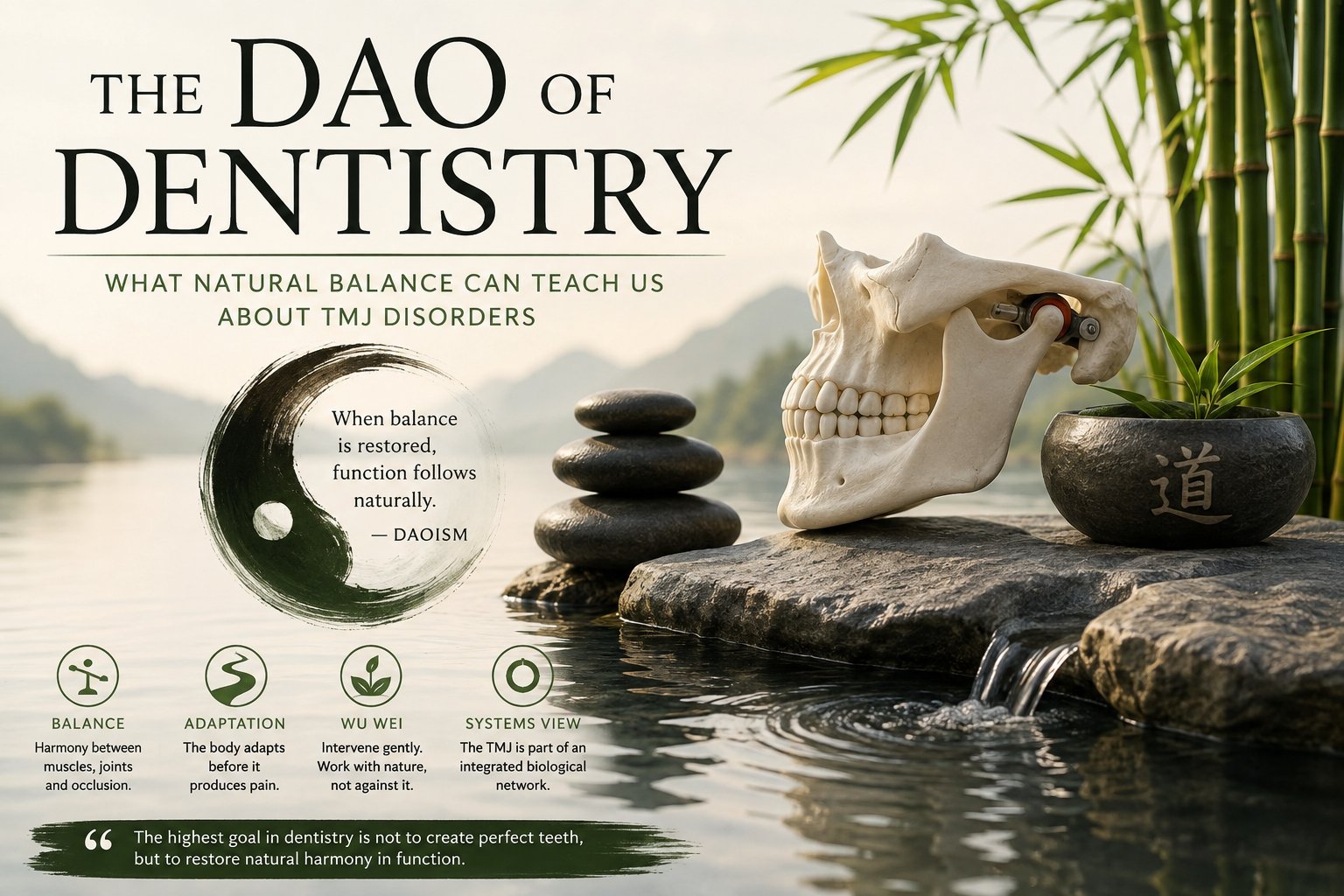
The Temporomandibular Joint and the Principle of Balance: Reflections from Daoist Philosophy
There is a particular moment in clinical dentistry that is easy to overlook. A patient sits in the chair with a painful temporomandibular joint, fatigued muscles, restricted movement or a history of recurrent symptoms. The radiograph may show a disc displacement or degenerative change. The occlusion may appear less than ideal. Yet the image does not always explain the patient in front of us.
Some patients with substantial structural changes remain comfortable for years. Others develop significant pain and dysfunction despite relatively modest radiographic findings. The discrepancy is not an argument against anatomy, imaging or biomechanics. It is a reminder that the temporomandibular joint is part of a biological system whose behaviour cannot always be inferred from one component.
Contemporary understanding of temporomandibular disorders (TMDs) has moved considerably from the idea that symptoms can be attributed to a single mechanical abnormality. The Diagnostic Criteria for Temporomandibular Disorders (DC/TMD) established a more reliable framework for distinguishing physical diagnoses from pain-related and psychosocial dimensions of the disorder.¹–⁴ The literature increasingly describes TMD as heterogeneous and multifactorial, involving interactions between peripheral tissues, neuromuscular function, pain processing, behaviour and psychosocial influences.⁵
It is in this context that an idea from a very different intellectual tradition becomes interesting.
Daoism does not offer a treatment protocol for TMD. It cannot diagnose a displaced disc, quantify muscular activity or determine an occlusal relationship. Its contribution is philosophical. It asks us to consider health not as a fixed state of perfection, but as a dynamic relationship between opposing and complementary forces.
That distinction has an unexpected relevance to dentistry.
The familiar Daoist concept of yin and yang is often interpreted simply as a symbol of opposites. Its deeper implication is that the apparent opposites are interdependent. Activity requires rest; movement requires stability; adaptation occurs because a system is continuously responding to change.
The masticatory system behaves in much the same way.
The mandible does not remain stationary. The muscles of mastication are continuously adjusting their activity. The temporomandibular joints accommodate movement. Periodontal and other sensory receptors provide information about the forces being generated. The nervous system integrates this information and modifies motor behaviour accordingly.
What we call occlusion is therefore not merely a static relationship between upper and lower teeth. It exists within a moving, responsive neuromuscular environment.
This becomes important when we consider the word “balance”.
In dentistry, balance can easily be confused with symmetry or perfection. Yet biological systems are rarely symmetrical and almost never perfect. Small differences between the two sides of the face are normal. Mandibular movements are not mathematically identical from one side to the other. Occlusal contacts vary between individuals and change throughout life.
The presence of a difference, therefore, does not by itself establish disease.
This is particularly relevant to the long-standing discussion surrounding occlusion and TMD. Occlusal characteristics have been associated with TMD in observational studies, but the evidence does not support reducing TMD to a simple occlusal disorder or assuming that an observed occlusal discrepancy is necessarily its cause.⁶,⁷ The distinction between association and causation is important because it determines how aggressively a clinician should intervene.
I have written previously on DentistryUnited about the relationship between dental occlusion and the temporomandibular joint, and about neuromuscular approaches to occlusal analysis. Those discussions arose from a clinical interest in understanding the relationship between teeth, muscles, mandibular movement and the joints rather than considering each in isolation.
With experience, however, the question becomes more nuanced.
The presence of an occlusal discrepancy may be clinically relevant without being the explanation for a patient’s pain. Conversely, an apparently minor functional disturbance may become important in a patient whose adaptive capacity has already been reduced by other factors.
The distinction is subtle, but it changes the clinician’s approach.
Rather than asking only where the anatomy differs from an ideal, we can ask why the patient has become symptomatic, what has changed, and how well the system is adapting to its present demands.
That is where the concept of adaptation becomes central.
The human body does not preserve function by maintaining every component in one fixed position. It preserves function by continuously adjusting. Muscles alter their recruitment. Movement patterns change. Sensory feedback modifies motor output. Behaviour changes in response to discomfort. These mechanisms can compensate for considerable variation before symptoms become clinically apparent.
In some patients, symptoms may represent the point at which previously successful adaptation becomes insufficient.
This does not mean that every TMD is a problem of “compensation”, nor that a particular mandibular position represents the hidden solution to every disorder. Such conclusions would go beyond the evidence. It does mean that a patient’s capacity to adapt deserves consideration alongside the structural findings.
This perspective is consistent with the broader evolution of TMD research. The biopsychosocial model proposed by Suvinen and colleagues more than two decades ago argued for the integration of physical and psychosocial factors in understanding temporomandibular pain.⁵ Contemporary approaches have continued in that direction, recognising that pain intensity, disability, tissue findings and psychological factors do not necessarily move together.³,⁵
For the clinician, this makes diagnosis more demanding but also more meaningful.
A joint may look abnormal without being the principal source of pain. A muscle may be tender without being the original cause of dysfunction. An occlusal contact may be present without requiring correction. Conversely, a relatively subtle alteration may become clinically significant within a particular patient’s functional environment.
The question is therefore not simply whether something is abnormal.
The more useful question may be whether the finding is relevant to this patient, at this time, in this functional context.
This is perhaps where the Daoist concept of Wu Wei provides another useful metaphor.
The term is often translated as “non-action”, although that translation can be misleading. It is closer to acting without unnecessary force—working with the nature of a system rather than imposing an external order upon it.
There is a clinical lesson here.
The presence of TMD does not automatically demand irreversible alteration of the dentition. Careful history, examination, pain assessment, functional evaluation and appropriate imaging may reveal that the most rational first step is conservative management. Education, behavioural modification, physiotherapy, pharmacological approaches, splint therapy or referral may be appropriate depending on the diagnosis and individual circumstances.³,⁸
Doing less is not the same as doing nothing.
Sometimes it is simply the more disciplined form of intervention.
This principle also changes how an occlusal appliance may be viewed. In my earlier writing on dental splints and neuromuscular dentistry, I discussed the role of reversible appliances in the management and assessment of selected patients.
A splint should not be regarded as a device capable of universally “correcting” the temporomandibular joint. Its value is more appropriately considered within the context of the individual diagnosis. In a suitable patient, a reversible intervention can provide protection, reduce loading or parafunctional effects, and provide information about how the patient’s symptoms respond to a change in the functional environment.
That information can be clinically valuable precisely because it is obtained without immediately committing the patient to irreversible treatment.
The same principle applies to restorative and occlusal rehabilitation.
There is a difference between creating an occlusion that appears ideal on a mounted model and creating a functional environment that a particular patient can tolerate over time. Digital dentistry has made it increasingly easy to measure and reproduce relationships with extraordinary precision. The challenge is to ensure that technological precision is not mistaken for biological certainty.
A measurement is not a diagnosis.
An anatomical variation is not necessarily a disease.
And a theoretically ideal position is not automatically a clinically necessary one.
This does not diminish the importance of occlusion. It places occlusion within its proper context.
The same caution applies to neuromuscular dentistry. The concept of examining the relationship between muscular function, mandibular position and occlusion remains clinically interesting. It encourages the dentist to look beyond tooth contacts and consider the functional system as a whole.
But a useful clinical model should remain open to evidence.
There is insufficient basis to claim that every patient with TMD possesses a single discoverable mandibular position that will resolve the disorder, or that occlusal correction is universally indicated. Such claims would oversimplify a field in which the biological and psychosocial determinants of pain are demonstrably complex.
The strength of a functional approach lies not in replacing one dogma with another, but in broadening the examination.
This is also why the word “natural” requires caution.
Nature is not synonymous with good.
A natural biological state can include disease, degeneration and pain. The objective of treatment cannot therefore simply be to return the patient to an undefined “natural” position.
What is useful about the Daoist idea of natural balance is something more modest: the recognition that biological systems possess their own patterns of adaptation and that intervention should respect those patterns rather than assume that every deviation from an ideal requires correction.
The distinction matters particularly in TMD, where irreversible treatment can carry consequences disproportionate to the certainty of the diagnosis.
The modern dentist has access to technologies that previous generations could not have imagined. Magnetic resonance imaging can visualise the disc. Cone-beam computed tomography can reveal osseous anatomy. Digital scanners can reproduce the dentition. Mandibular tracking and electromyography can provide additional functional information. Artificial intelligence is beginning to assist with image interpretation and clinical decision-making.
Yet better measurement does not eliminate the need for judgement.
If anything, it increases it.
The more information we obtain, the greater the responsibility to distinguish what is measurable from what is clinically meaningful.
Perhaps this is where the ancient idea of balance becomes unexpectedly relevant.
A biological system is stable not because nothing changes, but because it can accommodate change. Stability is therefore dynamic. It is maintained through continuous adjustment rather than immobility.
The temporomandibular system is no different.
The goal of treatment should consequently not be an abstractly perfect joint or an immaculate occlusal scheme. It should be a patient who can function comfortably and sustainably, with an appropriate understanding of the risks, benefits and limitations of the available interventions.
For one patient, that may mean conservative care.
For another, an appliance or physiotherapy.
For another, management of parafunctional or behavioural factors.
For a carefully selected patient with a clearly defined restorative problem, it may eventually involve orthodontic, restorative or prosthodontic intervention.
The treatment should follow the diagnosis, rather than the diagnosis being constructed to justify the treatment.
This may seem an obvious principle. In complex clinical conditions, however, it is one worth repeating.
The purpose of bringing Daoist thought into a discussion of TMD is therefore not to replace contemporary science with an ancient philosophy. The two belong to different domains. Modern medicine provides methods for diagnosis and evidence; philosophy can sometimes provide a different way of thinking about what the evidence means.
What is interesting is where the two perspectives meet.
Contemporary TMD research increasingly cautions against attributing pain to a single anatomical finding. Clinical experience similarly teaches us that not every deviation from an ideal occlusion requires correction. The masticatory system is adaptive, and adaptation is itself a form of biological intelligence.
Perhaps this is where the idea of balance becomes useful.
A healthy system is not necessarily one in which every component occupies a theoretically perfect position. It is one that can accommodate function without persistent pain, excessive muscular demand or progressive loss of capacity.
The dentist’s task may therefore sometimes be less about imposing a new position and more about understanding why the existing system has ceased to cope—and deciding, carefully, what intervention, if any, will allow it to function again.
That is a modest proposition.
But after decades of increasing technological precision in dentistry, it may also be an important one.
References
- Schiffman E, Ohrbach R, Truelove E, et al. Diagnostic Criteria for Temporomandibular Disorders (DC/TMD) for Clinical and Research Applications. J Oral Facial Pain Headache. 2014;28:6–27.
- Dworkin SF, LeResche L. Research Diagnostic Criteria for Temporomandibular Disorders: review, criteria, examinations and specifications, critique. J Craniomandib Disord. 1992;6:301–355.
- Schiffman E, Ohrbach R. Executive summary of the Diagnostic Criteria for Temporomandibular Disorders for clinical and research applications. J Am Dent Assoc. 2016;147:438–445.
- Ohrbach R, Dworkin SF. The evolution of TMD diagnosis: past, present, future. J Dent Res. 2016;95:1093–1101.
- Suvinen TI, Reade PC, Kemppainen P, Könönen M, Dworkin SF. Review of aetiological concepts of temporomandibular pain disorders: towards a biopsychosocial model. Eur J Pain. 2005;9:613–633.
- Manfredini D, Lombardo L, Siciliani G. Temporomandibular disorders and dental occlusion. A systematic review of association studies: end of an era? J Oral Rehabil. 2017;44:908–923.
- Pullinger AG, Seligman DA, Gornbein JA. A multiple logistic regression analysis of the risk and relative odds of temporomandibular disorders as a function of common occlusal features. J Dent Res. 1993;72:968–979.
- List T, Jensen RH. Temporomandibular disorders: Old ideas and new concepts. Cephalalgia. 2017;37:692–704.
Author:
About the Author
Dr. Syed Nabeel, MFDRCSI (Ireland), MFDS RCPS (Glasgow), MFDS RCS (Edinburgh) is a dentist, clinician and educator with more than two decades of experience in clinical dentistry, orthodontics and functional oral rehabilitation. He has been practising since 2002 and is the founder of Smile Maker Clinics and DentistryUnited, an independent dental education and professional knowledge platform established in 2004.
His clinical interests include neuromuscular dentistry, temporomandibular disorders, orthodontics, full-mouth rehabilitation, aesthetic dentistry and digital treatment planning. His clinical philosophy places particular emphasis on understanding the relationship between the dentition, masticatory muscles, temporomandibular joints and the wider neuromuscular system.
Dr. Nabeel is also the Editor-in-Chief of Dental Follicle, a dental publication established in 2006, and has been involved in professional dental education through DentistryUnited Academy.
His writing explores the intersection of clinical dentistry, science, technology, philosophy and systems thinking, with a particular interest in how dentistry can move beyond isolated structures towards a more integrated understanding of biological function.