
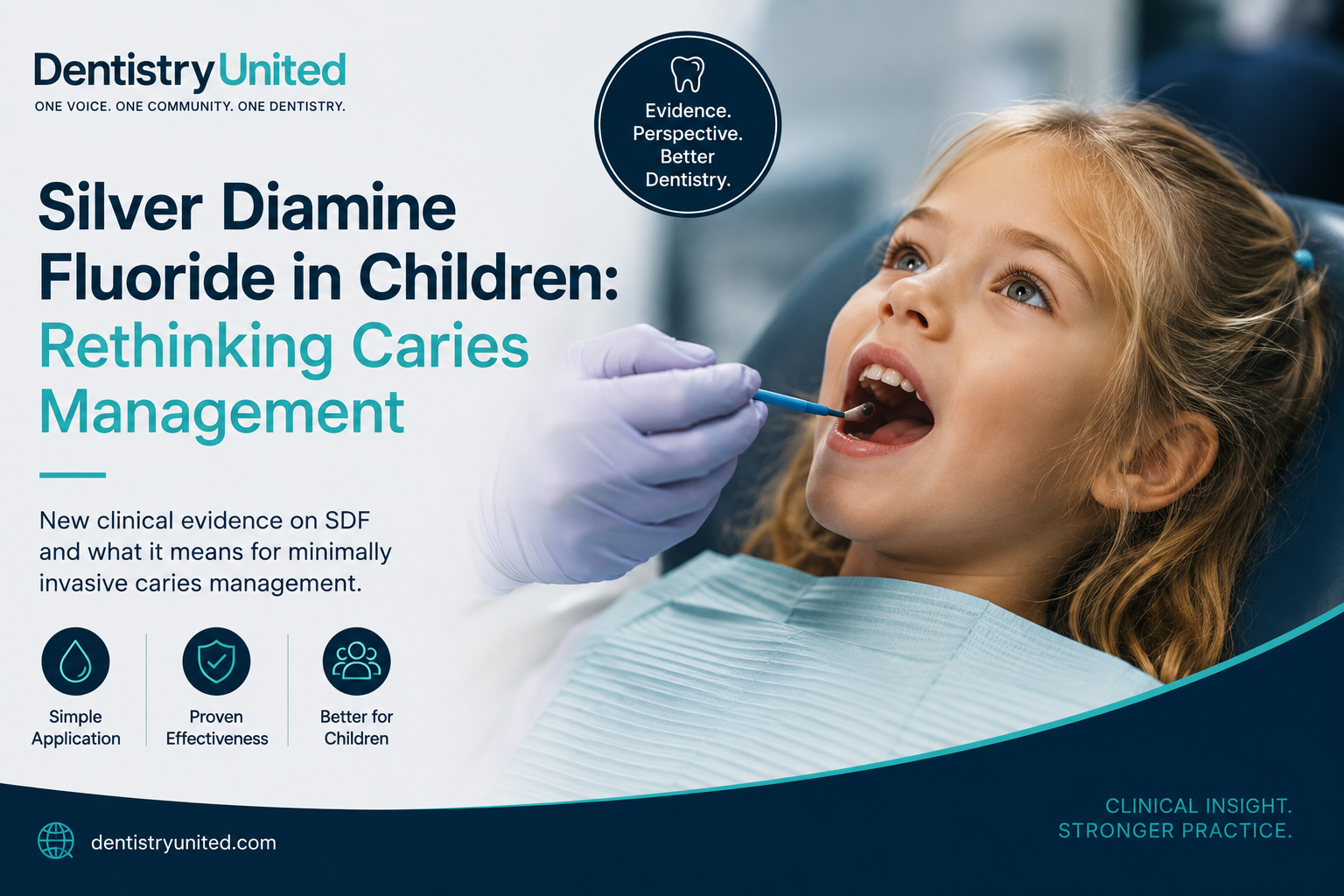
Silver Diamine Fluoride: A Small Change in Treatment, or a Larger Change in How We Think About Caries?
A clinical advisory by Dr Syed Nabeel
There are certain papers in dentistry that are interesting because they introduce something new. Then there are papers that make us pause and reconsider something we thought we already understood.
The recent phase III multicenter clinical trial on 38% silver diamine fluoride (SDF), published in JAMA Pediatrics, belongs to the second category.
The study involved 830 children between one and six years of age with severe early childhood caries. After one application, 54.0% of the treated cavitated dentinal lesions were arrested at six months, compared with 22.5% in the placebo group. The difference was statistically significant, with an odds ratio of 4.06 favoring SDF.
Those numbers are worth knowing.
But for a practicing dentist, the more interesting question is what those numbers actually mean when a child is sitting in the dental chair.
We have become very good at repairing teeth
For generations, the language of operative dentistry has been centered around removal and replacement.
We remove caries.
We prepare the tooth.
We restore what has been lost.
There is nothing wrong with that approach when it is appropriate.
But a three-year-old with severe early childhood caries is not simply a small adult with smaller teeth.
The child may have several affected teeth, limited cooperation, considerable anxiety and a treatment requirement that may extend well beyond what can realistically be accomplished in a conventional appointment. In some cases, comprehensive treatment may eventually require sedation or general anaesthesia.
So the clinical question changes.
It is no longer only:
How do I restore this tooth?
It may first become:
How do I control this disease until I can restore this tooth properly?
That is where SDF becomes interesting.
What the new trial tells us
The trial was designed specifically to evaluate whether 38% SDF could arrest active cavitated dentinal caries in the primary teeth of young children with severe early childhood caries.
The investigators recruited through dental and medical settings as well as preschool and community programmes. Children received either SDF or placebo, with clinical assessments at baseline, three, six and eight months.
The primary endpoint was lesion arrest at six months after one application.
The result was clear.
54.0% of lesions in the SDF group were arrested, compared with 22.5% in the placebo group.
At three months, the corresponding figures were 57.5% and 18.8%. Following a second application, the eight-month figures were 50.2% and 17.4%.
This is important evidence.
But there is another number that deserves equal attention.
Approximately 30% of the enrolled children did not complete the study; COVID-19 was one of the factors contributing to loss to follow-up. The investigators addressed missing data using an intention-to-treat approach.
Good clinical interpretation requires us to hold both facts in our minds at the same time.
The treatment worked significantly better than placebo.
It did not arrest every lesion.
Both statements are true.
Arrest is not the same thing as restoration
This is perhaps the most important point for clinicians—and for parents.
SDF does not rebuild a tooth that has already lost its structure.
A cavitated lesion remains a cavitated lesion.
What changes is its biological behaviour.
The lesion becomes harder and the progression of caries may be arrested. The purpose is therefore disease control, not anatomical reconstruction.
This is why I would hesitate to describe SDF simply as an alternative to a filling.
It is doing something different.
A restoration replaces lost tooth structure.
SDF attempts to stop the biological process that is continuing to destroy that structure.
There are situations in which we need one.
There are situations in which we may need the other.
And there are situations in which we may need both—just not necessarily on the same day.
The black tooth is not a trivial issue
There is, of course, a part of SDF that no clinician can ignore.
The treated carious tissue becomes dark.
For some parents this is difficult to accept, particularly when an anterior tooth is involved. For others, especially when posterior primary teeth are involved, the colour change may be a reasonable trade-off if it allows the child to avoid drilling, injections or a more extensive procedure at that particular stage.
This is where informed consent becomes more than a signature.
Parents need to understand what the treatment is trying to achieve, what it cannot achieve, and what the tooth may look like afterwards.
The decision should therefore be clinical, not fashionable.
SDF should not be used because it is new.
It should not be rejected because it stains.
The question is whether it is appropriate for this child, this lesion and this stage of treatment.
One important finding is what SDF does not do
The trial does not give us permission to say that SDF replaces conventional treatment.
In fact, the study provides a useful reminder of the opposite.
A substantial proportion of lesions remained unrested.
The investigators conclude that SDF is an effective intervention for arresting dentinal caries, while also recognizing that it should be used alongside other preventive strategies.
This matters because caries is not simply a hole in a tooth.
It is a disease process.
If we arrest one lesion but leave the underlying disease environment unchanged, we have treated a consequence without necessarily changing the patient’s risk.
Dietary habits, oral hygiene, fluoride exposure, parental understanding and regular clinical review remain part of treatment.
SDF is a tool.
It is not a philosophy of care by itself.
Where I think this becomes particularly valuable
The real attraction of SDF, in my view, is not that it gives dentistry a way of avoiding restorative treatment.
It gives us a way of changing the timing of restorative treatment.
That distinction is clinically significant.
A child may not cooperate today.
The family may need time to organize definitive treatment.
The clinician may need to control active disease before undertaking a larger rehabilitation.
A young patient may simply benefit from growing older and becoming more capable of accepting treatment.
In these circumstances, arresting disease can be a meaningful clinical outcome.
It buys something that dentists do not always recognize as a therapeutic resource:
time.
But diagnosis still comes first
The simplicity of applying SDF should never make the diagnosis simple.
A child presenting with pain, pulpal involvement, swelling, fistula, infection or significant structural destruction requires a different clinical assessment.
SDF should not become an excuse for postponing treatment that the tooth clearly requires.
Nor should a successful arrest be interpreted as permission to stop monitoring the child.
The trial itself reinforces this point. The investigators observed that not all lesions arrested and emphasized the need for continued management rather than reliance on SDF alone.
This is where dentistry remains what it has always been at its best: a combination of evidence, diagnosis and judgement.
Perhaps the larger lesson is not about silver
I think there is a larger conversation here.
For a long time, we have measured successful dentistry by what we were able to repair.
Modern caries management is gradually asking us to measure success differently.
Sometimes success is a restoration that functions beautifully for many years.
Sometimes it is preservation of sound tooth structure.
And sometimes, particularly in a very young child, success may simply mean that a rapidly progressing lesion has stopped progressing while we prepare for the next stage of care.
That is not lesser dentistry.
It is often more conservative dentistry.
The important change is not that we have found a liquid that can stop some cavities.
The important change is that we are becoming more comfortable with the idea that disease control and restoration do not always have to happen at the same time.
That is a subtle change.
But clinical practice often changes through subtle changes in thinking rather than dramatic changes in technology.
My view
I would therefore place SDF where it belongs—not at the centre of paediatric dentistry, and certainly not outside conventional dentistry, but within the expanding spectrum of minimally invasive caries management.
The new evidence makes the case stronger.
It tells us that, in young children with severe early childhood caries, 38% SDF can arrest a substantial proportion of active cavitated dentinal lesions and performs considerably better than placebo.
It also tells us something equally important: approximately half of the lesions did not meet the arrest endpoint at six months.
That should make us neither dismissive nor overenthusiastic.
It should make us clinical.
The best dentistry has never been about using the newest material simply because it exists.
It has always been about knowing when not to intervene, when to intervene, and how much intervention the patient actually needs.
SDF gives us another answer to that question.
And sometimes, for a very young child, the most appropriate first step may not be to repair the cavity.
It may be to stop the disease, preserve what remains, and wait for the right moment to do the rest.
About the author
Dr Syed Nabeel, BDS, D.Orth, MFDRCSI, MFDS RCPS, MFDS RCS
Dr Syed Nabeel has been practising dentistry since 2002, with clinical and academic interests spanning orthodontics, neuromuscular dentistry, temporomandibular disorders, comprehensive restorative care and the evolving role of digital technologies in clinical decision-making.
He is the Founder and CEO of DentistryUnited, an online professional platform established to bring dental learning, clinical discussion and research closer to practising dentists. He is also the Editor-in-Chief of Dental Follicle and Clinical Director of Smile Maker Clinics, Mysuru.
Over the years, his work has increasingly focused on a question that sits at the intersection of clinical dentistry, technology and education: as our ability to diagnose and treat disease becomes more sophisticated, are we also becoming better at deciding when treatment is actually necessary?
This advisory is part of that continuing conversation.
Original research
Fontana M, Moursi A, Gonzalez-Cabezas C, et al. Efficacy of Silver Diamine Fluoride on Young Children With Severe Early Childhood Caries: A Randomized Clinical Trial. JAMA Pediatrics. Published online July 27, 2026. doi:10.1001/jamapediatrics.2026.2567.